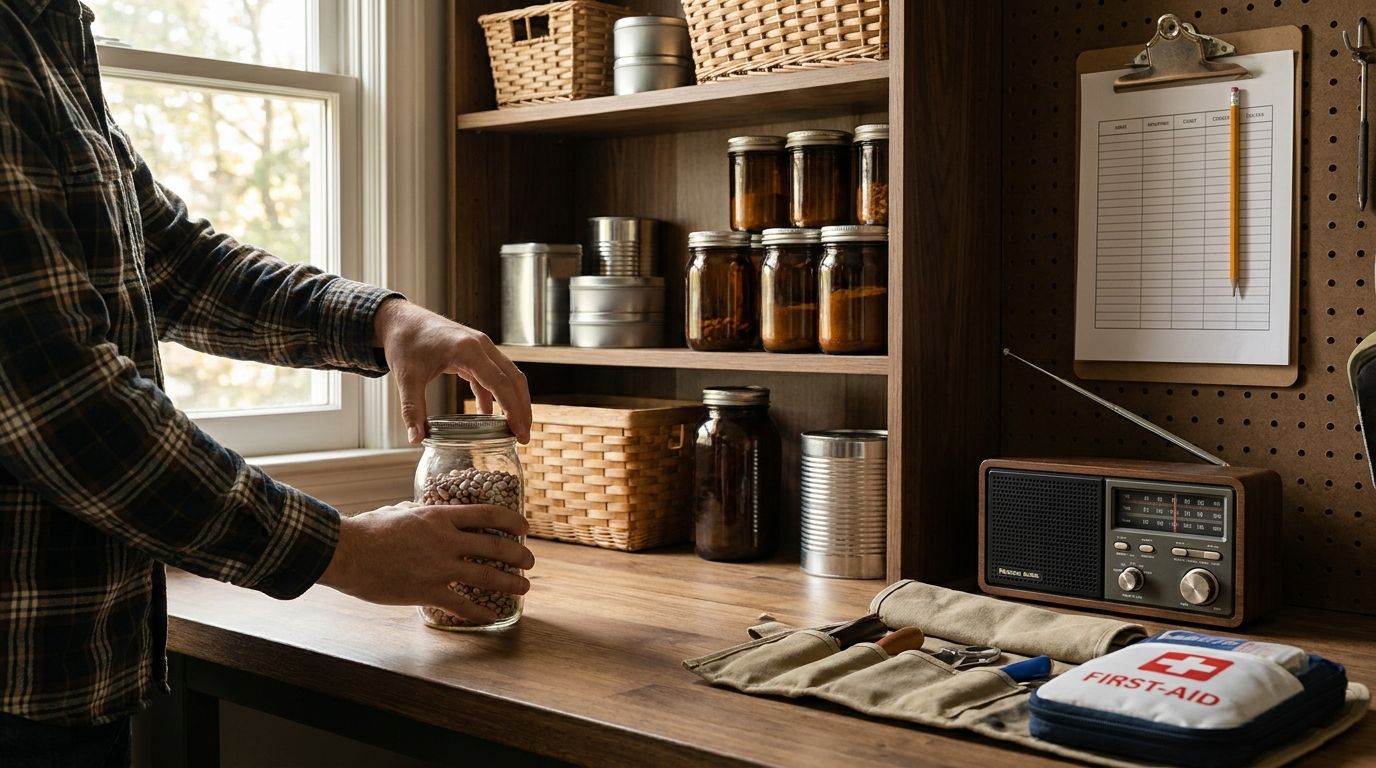
Build a shelf-life map: labeling that tells you what expires first
A shelf-life map turns guessing into a simple visual system. You’ll know what expires first, refill faster, and keep inventory rotation clean.

You open the pantry and see three bags of rice stacked behind each other. You stare at the labels, then at the dates, then at the ceiling like the answer is written up there. A shelf-life map fixes that. It's a labeling and layout system that tells you what expires first before you even start pulling items.
The thesis is simple: when your shelf-life labeling matches the way you actually store and access supplies, expiry tracking becomes automatic. You get a FIFO system you can maintain without a spreadsheet obsession, and it works for both long-term staples and the stuff you use every week.
What a shelf-life map is (and what it is not)
A shelf-life map is a visual inventory rotation plan. Not a fancy database. Not a single label on the front of a container that still leaves you wondering what's sitting behind it.
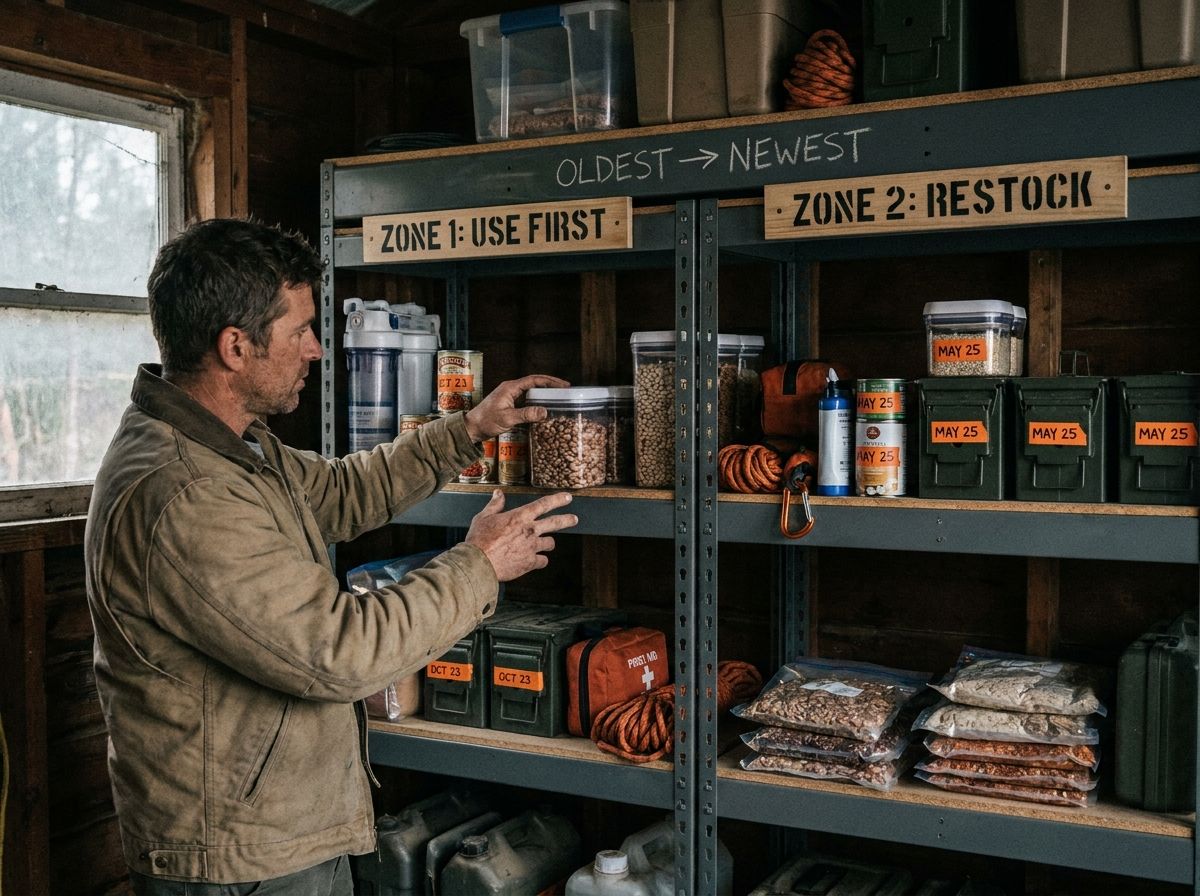
Think of your storage area like a street map. Each shelf, bin, or cabinet zone gets a "flow direction" and a consistent label format. When you add new items, you place them in the correct zone so the oldest items naturally move forward. That is inventory rotation, made physical.
In a prepper labeling system, the map usually shows:
- Storage zones (for example, "Kitchen shelf 1," "Garage bin A," "Basement shelf 3")
- Expiry order rules (for example, oldest goes forward, newest goes back)
- Label fields that you can read in seconds (product name, purchase date or pack date, expiry date or best-by date, quantity)
You do not need perfect data. You need consistent data. If you have a mix of "best by" and "use by" dates, write them down exactly as printed. Your shelf-life map is for decision-making, not for arguing with labels.
One more thing: a shelf-life map is built to survive real life. It's built for the moment you are tired, carrying a bag of rice to the counter, and you still need to grab the right item. If your system only works when you are fully awake and holding a clipboard, it will fail.
With Mainstay's adaptive learning system, you can keep your inventory rotation habits aligned with your actual storage layout, so expiry tracking stays consistent as your supply grows.
Choose your labeling fields so you can act fast
Shelf-life labeling fails when it asks you to do extra work. Your labels should answer the one question you actually have in the moment: "What do I grab today that will expire first?"
Start with a small set of fields. Write them on a label, print them, or run them through a label maker. The goal is the same either way.
Here is a practical label format that works for most pantry and storage items:
- Item name (what it is)
- Pack date or purchase date (when you started tracking)
- Expiry date or best-by date (when it becomes questionable)
- Quantity (count, weight, or number of units)
- Zone code (where it lives on the shelf-life map)
If you want one extra field, add "lot" or "batch" when it's printed on the packaging. That makes recalls easier and helps you catch inconsistencies between batches.
Use date rules that match how supplies behave
Not every item follows the same shelf-life pattern. Dry goods like rice and beans often use "best by" dates that assume unopened storage. Canned goods use "best by" as well, but the quality curve can shift depending on storage conditions. Medications and some specialty items follow different labeling rules entirely.
So you standardize your tracking method:
- For food, track the printed best-by date and treat it as your expiry tracking date.
- For supplements, use the printed expiration date.
- For first aid and consumables, track the printed expiration date where applicable, and track "service life" or "replacement interval" if no date exists.
A common mistake is mixing date types without noting them. Your shelf-life map should make the rules obvious.
Keep it readable at arm's length
If you need to hold a container up to your face, your label is too small. If you need a flashlight to read it, your label is too dim. Put the most important date field where your eyes land first.
Label the container and the shelf zone. That way, even if someone moves a bin, you still know where it belongs.
Build the FIFO system on top of your storage layout
A FIFO system works when the physical layout matches the rotation rules. If "oldest goes forward" is true on paper but not on your shelves, you will still end up digging for the older items.
So build the shelf-life map as a layout decision first.
Define zones with clear boundaries
Pick zones that match how you access items. Kitchen shelves and pantry bins are one thing. Garage shelving and basement bins are another.
Use zone codes that make sense to you. For example:
- K1: Kitchen shelf closest to the stove
- P2: Pantry bin on the left side
- G1: Garage shelf at eye level
- B3: Basement shelf behind the water jugs
When you label, include the zone code.
Set an "inflow" and an "outflow" direction
Your shelf-life map should show where new items enter and where used items exit.
A simple rule: new items go to the back or bottom of the zone, and used items come from the front or top of the zone. That is the heart of inventory rotation.
Use a "front row" concept
If a zone holds multiple containers, treat the front row as the pick zone. Put the oldest items there, newest items behind them. When you use something, slide the next oldest forward.
This is how you avoid the "I used the newest one because it was easiest to reach" problem.
Scenario: the rice stack that always messes you up
Picture a Tuesday night in your kitchen. You grab rice for dinner, pull the front bag, then notice the date. The front bag is newer than the one behind it.
That is not a discipline problem. That is a layout problem.
Fix it with a front row approach: Bag A (older best-by) goes in the front row, Bag B (newer best-by) goes behind it, and when Bag A is gone, you slide Bag B forward. Your shelf-life map makes that slide a routine move, not a mental debate you have while you're hungry.
Turn expiry tracking into a weekly habit, not a yearly project
You can build a perfect shelf-life map and still fail if you never check it. The trick is making expiry tracking small enough that you actually do it.
You do not need a full audit every time. You need a routine that touches the labels you rely on.
Use a "touch list" for what matters
Make a short list of what you rotate most often and what carries the shortest practical shelf life.
Examples:
- Opened shelf-stable foods (opened items often have shorter real timelines than unopened)
- Baking supplies (flours and leavening can go stale)
- Freeze-dried or dehydrated meals (quality drops over time even if safe)
- Canned goods with dents or compromised seals (inspect and prioritize)
Your shelf-life map should point you to the zones you check.
Do a 5-minute check per zone
Pick a day. Do not wait for a crisis. Walk to each zone, scan the labels, and move the oldest item into the front row.
If you want a rule that keeps you honest: if an item is within your "rotation window," you use it next; if it is outside the window, you leave it. You decide your rotation window based on your comfort and your consumption rate.
Scenario: Sam Wills and the garage bin
On a Saturday morning, Sam Wills is in the garage getting ready for a project. He opens bin G1 and sees two buckets of powdered drink mix. One has a best-by date next month. The other has a best-by date six months away.
He does not do a deep dig. He pulls the older one first, because the front row is supposed to hold the oldest item. Then he updates the shelf-life map with the quantity left.
That is the win. He did not "remember" anything, the system told him.
Use refill triggers so you reorder before you run out
A shelf-life map helps you decide what expires first. Reorder triggers help you decide what to buy next.
You can set refill triggers based on consumption and the date window. The simplest version: if you have less than X units left in a zone, reorder; if the expiry date is within your rotation window, reorder earlier. This is how inventory management stays calm.
Handle mixed packaging, repacks, and "mystery dates" without losing control
Your shelf-life map will break if you treat every container the same. In real life, you will repack items, buy in bulk, and sometimes end up with packaging that has no clear date.
So you build rules for the messy cases.
Keep original packaging when it has the best date info
If the original bag or can has the clearest "best-by" or "pack" date, keep it. If you repack, copy the date onto your new container.
That way your prepper labeling system still gives you expiry tracking without guesswork.
When you repack, you create a new tracking start date
If you open a bulk bag and portion into smaller containers, track from the repack date. Write "Repacked on" plus the date you filled the container. Then also write the original best-by date if it exists.
Use "unknown" labels only as a temporary placeholder
If you truly have no date, label it "unknown date." Put it in its own zone temporarily so it does not contaminate your rotation logic.
Then do one of these: replace it with a dated item, use it sooner, or determine the date from batch info if you can find it. A shelf-life map is not a place for forever-unknowns.
Scenario: the basement shelf behind the water jugs
It is late fall. You are checking basement storage in the same spot you always do. You reach behind the water jugs and find a box of canned goods with labels partly rubbed off.
Your shelf-life map has a rule for this: unknown dates go into a "verify and use first" zone, dented cans get inspected and prioritized or removed, and once you verify dates, you move them into the correct zone. This prevents the "I thought it was older" problem from turning into real waste or a real safety issue.
Data points to keep your expectations realistic
A lot of people treat expiration dates as strict cutoffs. In practice, many food products use best-by dates for quality, not safety, especially when stored properly and unopened. The USDA notes that best-by dates are quality indicators and that many foods remain safe past the date if stored correctly, though you should rely on condition and appearance for opened or damaged items.
For dry goods, quality loss is usually driven by moisture and oxygen exposure. That is why repacking and container choice matter. Your shelf-life labeling system is the decision layer, but storage conditions still control the outcome.
Make your shelf-life map printable and repeatable
Your shelf-life map should be something you can maintain. Not something you reinvent every time.
So make it repeatable.
Choose one map per storage area
Do not try to map your entire house on one page. Create a map for each major area: kitchen/pantry, garage, and basement or closet storage. Each map carries the zone codes and the FIFO rules.
Add a "zone label" template
Print small zone cards or tape them inside cabinet doors. The zone label should include the zone code, oldest-to-newest direction, and label fields you use. When you add new items, place them in the correct zone and update the label.
Keep the map where you actually store supplies
If the map lives in a notebook on the other side of the house, it becomes a decoration. Put it where you do the work.
A laminated sheet on the inside of a pantry door is perfect. A simple printed map in a binder works too.
Scenario: prepper labeling system in action during a shopping run
You get home from the store. You bring in a case of canned chili and a bag of rice. Instead of finding random spots, you check your shelf-life map.
You see zone K1 is a FIFO zone with a front row. You place the newest containers into the back of K1, then slide the oldest forward so the front row stays oldest-first.
That is inventory rotation that happens without drama.
Where Mainstay fits
With Mainstay's adaptive learning system, your labeling and rotation rules stay consistent as your supply list grows. You spend less time figuring out what you have and more time using it and refilling what you are actually running low on.
FAQ
What should I write on shelf-life labels for food?
Write the item name, the printed best-by or expiry date, and the date you started tracking it if you repack. Add quantity so you can see how much you have without opening containers. If a label has no date, mark it as unknown and move it to a verify-and-use-first zone.
How do I set up a FIFO system when I have mixed containers?
Create zones by access level first, not by container type. Put the oldest items in the front row of each zone, regardless of whether they are bags, cans, or repacked tubs. When you add new stock, place it into the back of the zone so it naturally slides forward as you use items.
What is the best way to do expiry tracking without a spreadsheet?
Use zone codes and a front row rule. Do a quick weekly scan of labels in the zones you rotate most, and slide the next oldest item forward. Your "touch list" for what you check keeps the task small.
How often should I rotate supplies?
Rotate on a schedule you can keep, usually weekly or when you restock. The goal is not perfect timing. The goal is that you never reach for something and discover it is past your quality threshold.
What do I do with items that have no readable date?
Treat them as temporary. Label them unknown date, keep them in a separate verify zone, and use them sooner or replace them. A shelf-life map is only as good as the data feeding it.
Your next step: build one shelf-life map today
Pick one storage area you use every week, like your pantry or kitchen shelf. Define three zones, label them with zone codes, and set the oldest-to-newest direction.
Then label your top ten items with the same fields: item name, expiry or best-by date, quantity, and zone code. Spend five minutes doing one front-row pass so the oldest items are forward.
When you do the next shopping run, you will already know where new items go and what to use first.
Want this handled automatically? See the Mainstay membership.
Subscribe to comment
Join the Mainstay newsletter to leave a comment — and get new field notes in your inbox.
Get new field notes in your inbox
Practical, calm preparedness — one useful note at a time.