Emergency medication readiness: a practical home storage and refill guide
Build an emergency medication supply that stays organized, current, and usable when pharmacies, power, or routines are disrupted.
June Wills found the missing inhaler at 6:40 on a Tuesday morning, wedged behind a basket of clean towels. The prescription was current. The inhaler was not where anyone expected it to be, and everyone was already late.
Medication readiness comes down to two jobs: keep essential medicines in a known, protected spot, and build a refill habit before the last dose is close. A reliable supply isn't a giant stockpile. It's a current list, sensible storage, a small working reserve where the rules allow, and a clear way to replace what you use.
June stood in the hallway holding the inhaler while Rosa Wills dug through the kitchen drawer for the pharmacy number. Sam checked the family calendar and found a note about a refill, but nobody could say whether it had been picked up. The household had plenty of useful supplies, but it had simply never given medication the same orderly treatment it gave batteries or bottled water.

That's a familiar kind of failure. The medicine exists, but the information around it is scattered. One bottle lives in a bathroom cabinet. Another rides along in a work bag. The backup is somewhere in the car, possibly under a receipt from last winter.
You don't need to feel foolish about this. Prescriptions are tangled up with appointments, insurance rules, pharmacy hours, travel, work schedules, and shifting doses, so keeping the whole system current takes more attention than most households can spare on an ordinary week.
Start with a medication picture of your household
The first step in home medical preparedness is knowing what each person takes, how often they take it, and what makes that medicine sensitive to interruption. Include routine prescriptions, over-the-counter medicines used regularly, inhalers, injectable medicines, medical supplies, and anything used for a known allergy or condition.
A medication list earns its keep when it answers the questions a tired person would ask at a pharmacy counter. It can live in a document vault or on paper, but someone should be able to find it without unlocking three phones.
Record these details for every medicine:
- The person who uses it and the reason it is used.
- The exact name, strength, dose, and schedule.
- The prescribing clinician and pharmacy phone number.
- The prescription number, refill date, and insurance information.
- Storage instructions, including refrigeration or protection from light.
- What to do if a dose is missed, if that guidance is already provided by the prescriber or pharmacist.
- A note about allergies, side effects, or devices needed to use the medicine.
Don't rely on a bottle label alone. Labels fade, and a bottle may not travel with the person who needs the information. Keep a current printed copy with the household documents and a protected digital copy for when you have connectivity.
The U.S. Food and Drug Administration advises people to keep medicines in their original labeled containers when possible. That label carries the medication name, strength, directions, and expiration information. A weekly pill organizer may support daily routines, but it shouldn't replace the labeled container for storage or travel.
Check your list against the actual supplies on hand. This is where small gaps surface: a prescription changed from two tablets to one, a bottle migrated to a desk drawer, or the home kit still lists a medicine discontinued months ago.
What belongs in an emergency medication supply?
Your supply depends on health needs, prescribing rules, and the length of disruption you're planning around. A practical home reserve often includes:
- Current prescription medicines that a household member cannot safely stop without medical guidance.
- Common over-the-counter products your household already uses and tolerates.
- Delivery devices such as syringes, spacers, lancets, test strips, or battery support for a medical device.
- Copies of prescriptions, medication lists, and relevant insurance cards.
- A small travel pouch for medicines that must leave home quickly.
Don't add a medicine just because it appears on a generic checklist. A product that's safe for one adult can be risky for another because of allergies, pregnancy, age, kidney disease, drug interactions, or an existing prescription. Your pharmacist is the right person to sort through those details.
Store medications for the conditions they actually need
If you're figuring out how to store medications at home, start with the storage directions printed on the label. "Cool, dry place" usually doesn't mean the bathroom. Heat and moisture from showers can degrade some medicines even when the cabinet looks clean and tightly closed.
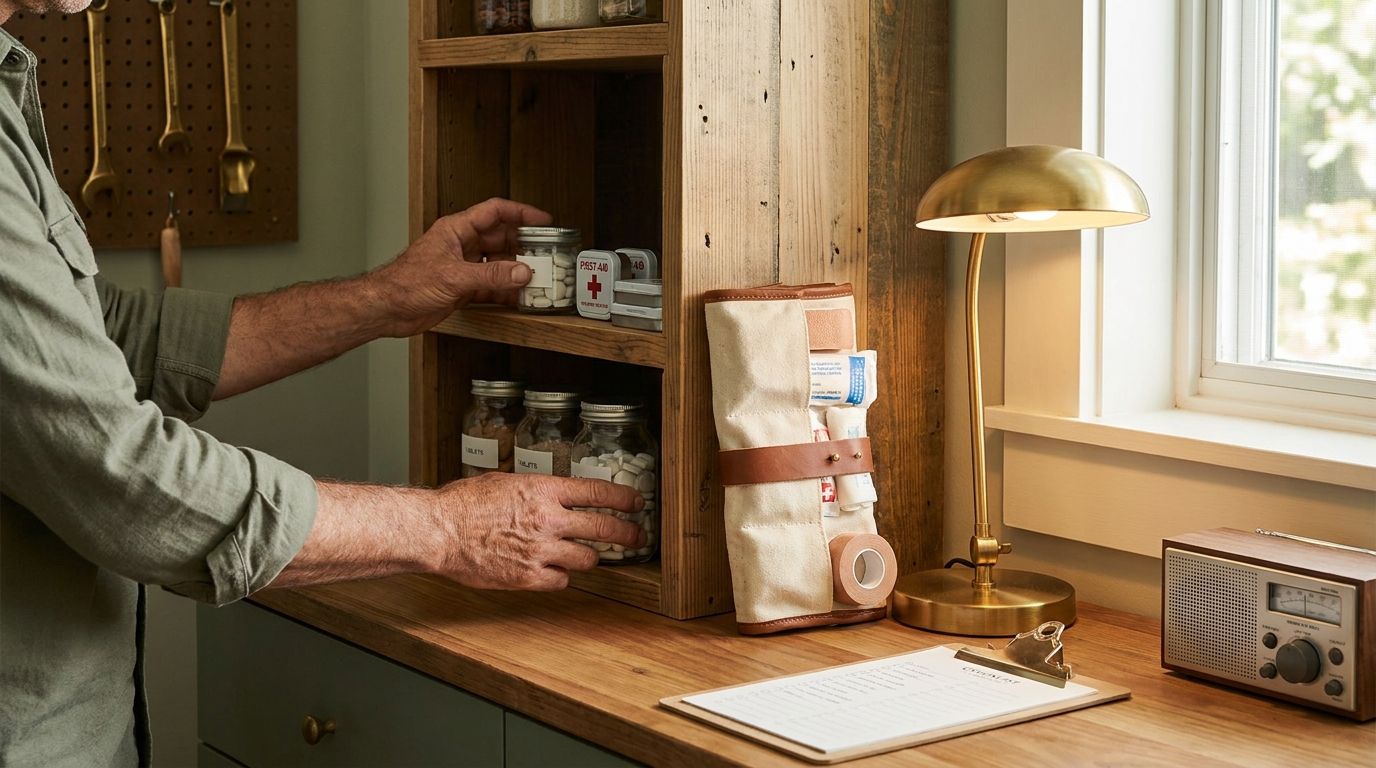
A hallway cabinet, bedroom drawer, or interior closet often works better. Choose a spot that's easy for adults to reach, protected from children and pets, and clear of ovens, sinks, radiators, direct sunlight, and vehicles. Scout, the Wills family dog, has never met a container he didn't want to investigate, so the household keeps medicines behind a latched cabinet rather than on a low shelf.
Temperature matters most for medicines that require refrigeration. The FDA says medicines should be stored according to their labels, and some products lose strength when exposed to heat or freezing. A power outage can turn a refrigerator into a question mark, so write down each medication's storage requirement before you're making decisions under pressure.
Call the pharmacist or prescribing office for product-specific guidance. Don't put insulin, biologics, liquid medicines, or other temperature-sensitive products in a freezer unless the label specifically allows it. And don't use a medicine that has changed color, texture, smell, or appearance without checking with a pharmacist first.
A storage check should cover more than the bottle itself. Keep the tools that make the medicine usable in the same general area, with a little separation for safety:
- Inhalers need any prescribed spacer or chamber.
- Injectable medicines may need needles, alcohol swabs, sharps disposal, or a carrying case.
- Liquid medicines need the correct dosing syringe or cup.
- Medicines that require light protection need their original packaging.
- Devices may need charged batteries, a power adapter, or a manual backup method approved by the clinician.
Store medicines in original containers whenever practical. If you move a small amount into a travel container, keep the original label and the medication list with it. Never combine different pills in one unlabeled container. That saves a few seconds and creates a real problem later.
Build an emergency prescription planning routine
Emergency prescription planning works best when it's tied to a routine refill point rather than memory. Pick one day each month to review the supply. The review can take ten minutes. No clipboard required, no special app, no organizational heroics.
Use the refill date to set a personal reorder point. If a medicine has 30 doses and the pharmacy typically needs several days to fill it, don't wait until the bottle is empty. Ask the pharmacy whether automatic refills, synchronized pickup dates, mail delivery, or a vacation supply are available options.
Rules for early refills vary by medicine, insurance plan, state, and pharmacy. Controlled substances carry additional limits. A pharmacist can walk you through what's legal and what the prescriber can request. Don't pressure a clinician to issue an unsafe amount, and don't stretch doses or skip treatment to build a reserve without medical instruction.
A simple refill review can follow this order:
1. Count the doses or units currently available.
2. Check the next appointment and prescription expiration date.
3. Contact the pharmacy about the next fill and any insurance restriction.
4. Ask the prescriber about a backup plan for a lost, damaged, or delayed prescription.
5. Record the refill date and update the household list.
If a medicine is essential, ask direct questions before a disruption occurs. Can the pharmacy transfer the prescription? Is there a nearby pharmacy with extended hours? What should happen if the medicine is lost? How should it be stored during travel? What symptoms mean you need urgent help rather than a refill?
Keep those answers with the medication record. Stress makes ordinary details slippery, and a written answer is kinder to your future self than a confident guess made at midnight.
The CDC has long included medication continuity in household health planning, and its public guidance encourages people to keep an updated medication list and plan for medicines and medical equipment during disasters. The practical point is plain: a prescription plan has to cover access, storage, information, and the supplies needed to actually use the medicine.
With Mainstay's inventory and preparedness plan tools, you can record the medicine, storage requirement, refill point, and next review date inside the same household system you use for other supplies. The tool is not the plan. It's the place that keeps the plan from disappearing into a drawer.
Make the plan usable when normal routines break
A medication plan is only useful if another capable adult can follow it. Write the instructions in plain language. Identify who takes what, where it's stored, and who can contact the pharmacy or clinician.
Build a small medication go-kit for each person with regular needs. Keep it separate from the main household supply area so it can leave the house without a full search. The contents should match the person, not a generic template.
A useful go-kit may include:
- The current medicine in its labeled container.
- A printed medication and allergy list.
- Prescriber, pharmacy, and insurance contact information.
- Approved dosing tools or delivery devices.
- A small protective pouch and any required temperature-control item.
- A written note about storage and missed-dose guidance.
Check the kit after travel, appointments, illness, and dose changes. Those are the moments when supplies move and records go stale.
Think about access problems in concrete terms. If the power is out, can you keep a temperature-sensitive medicine within its required range? If the car is unavailable, can someone reach the pharmacy on foot or by other means? If the primary caregiver is at work, can another adult identify the medicine and follow the written plan? If the household leaves quickly, is the go-kit near the documents rather than buried under camping gear?
Don't build a backup plan that depends on perfect cell service. Write down phone numbers and addresses. Save the medication list offline. Keep a small flashlight near the storage area, but not inside a cabinet where battery heat or clutter creates a separate problem.
How often should you check medication storage?
Review the medicine list at every dose change, new diagnosis, new pharmacy, or insurance change. Do a physical supply check at least monthly, then run a deeper expiration and storage review every three months.
During each review, look for:
- Expired or discontinued medicines.
- Damaged labels, cracked containers, or loose caps.
- Supplies that no longer match the delivery device.
- Medicines stored in the wrong location.
- Refill dates that fall near travel, holidays, or known pharmacy closures.
- Products that have been exposed to heat, freezing, moisture, or direct sun.
Don't flush unwanted medicines unless the label or local guidance specifically says to. The FDA recommends using a drug take-back option when available, and it maintains a disposal search tool for many areas. Ask your pharmacy about local collection options for medicines and sharps.
Expired medicine is not automatically harmless, and it's not automatically dangerous in the same way for every product. The safe call depends on the medicine, its storage history, and the consequence of reduced strength. A pharmacist can help you decide what needs prompt replacement and what can wait for a normal refill.
FAQ
How much medication should I keep at home?
Keep the amount your prescriber and pharmacist say is appropriate for your prescriptions, plus the routine over-the-counter products your household actually uses. Insurance and controlled-substance rules can limit early refills, so ask about refill synchronization, vacation supplies, and local policies rather than picking an arbitrary number.
Where is the safest place to store medications?
Follow the storage conditions on the label. For medicines marked "cool, dry place," an interior bedroom or hallway cabinet is usually better than a bathroom or kitchen area. Keep medicines in labeled containers, away from children and pets, and ask a pharmacist about products that require refrigeration or protection from light.
What should I do if medication needs refrigeration during a power outage?
Follow the product label and contact a pharmacist or prescriber for specific guidance. Keep the refrigerator closed as much as possible, don't freeze the medicine unless the label allows it, and write down how long the product was outside its required temperature range.
How do I create an emergency prescription plan?
List every medicine, dose, prescriber, pharmacy, refill date, storage requirement, and delivery supply. Set a refill review point before the bottle is empty, then write down what to do if the prescription is delayed, lost, or stored incorrectly.
A small next step for this week
Pick one medicine cabinet, drawer, or travel bag. Pull everything out. Match each item to a current list, check the label, and move anything that's in the wrong spot.
Then call the pharmacy about whichever prescription causes you the most low-grade concern. Ask one clear question about refills or storage and write down the answer. That single conversation may clear up more uncertainty than a much larger shopping trip.
June still checks the inhaler location before leaving the house. Rosa keeps the printed list with the household documents, and Sam updates the refill date after pickup. The routine is not dramatic. That is the point.
You're not failing because medication management feels complicated. You're carrying a system that was built across several offices, apps, schedules, and rulebooks. A clear list, a sensible storage spot, and a refill habit bring that system back under your roof, where it belongs.
Want this handled automatically? See the Mainstay membership.
Subscribe to comment
Join the Mainstay newsletter to leave a comment — and get new field notes in your inbox.
Get new field notes in your inbox
Practical, calm preparedness — one useful note at a time.