How to build a household emergency contact list that works under stress
Build a household emergency contact list that still works when phones fail, roads close, and nobody can remember the plan.

At 6:42 on a Tuesday morning, Priya found the school district alert while her phone was at 12 percent. A water main had broken near the elementary school, roads were closing, and her partner was already across town. A household emergency contact list is useful only when every person can find it, read it, and follow it while stressed. The answer is a short, printed and digital list with clear roles, an out-of-area contact, meeting places, and a simple check-in rule.
That is the thesis here: your list should remove decisions, not create another document to manage. You do not need a binder that looks like it belongs in a government office. You need the right names, numbers, addresses, and instructions on one page, with a copy in the places your household already reaches for.
Start with the job your list must do
A contact list has one job under stress: help each person decide who to call, where to go, and what message to send. It is not a general address book. Your dentist, former landlord, and the cousin who moved three states away may be useful elsewhere, but they do not belong on this page.
Write the list around real decisions. If the power goes out during a winter storm, you may need to reach your household, confirm a safe place, and tell one person outside the area that everyone is accounted for. If a child is released from school early, you may need an approved pickup person and a backup route. If a wildfire closes the usual road, you may need a second meeting point.
A useful household emergency contact list includes:
- Every household member's full name and mobile number
- One out-of-area contact who can relay messages
- Local emergency services and non-emergency police numbers
- School, workplace, daycare, and medical office contacts
- Two meeting places with full addresses
- A short check-in message and instructions for low battery situations
Use full names. "Mom" is clear until a neighbor finds the card, or until a phone contact syncs incorrectly. Add relationship or role in a separate column, such as "school pickup," "medical decision-maker," or "neighbor with spare key." Keep the wording plain enough that a tired person can scan it in ten seconds.
Ready.gov advises households to choose an out-of-area contact because a distant number may be easier to reach when local networks are congested. That person does not need to coordinate every detail. They need to receive short updates and pass them along. Choose someone calm, reachable, and willing to answer an unfamiliar call.Choose contacts by role, not by sentiment
Your favorite relative is not automatically the best contact. A useful contact is available, understands the household, and can take a specific action. Someone who lives nearby may reach your home quickly, while someone farther away may be more likely to get through when local service is jammed. Those are different roles.
Build your family emergency contacts around four jobs:
- Household contact: the person responsible for checking on everyone during a normal disruption
- Local helper: a trusted person who can reach the home, school, or pet if roads allow
- Out-of-area relay: the person who receives updates and shares them with the household
- Professional contact: school, workplace, utility, medical, insurance, and care providers
A practical example is Martin's household in Fort Collins, Colorado. Martin works nights, his sister lives ten minutes away, and his father lives in Kansas. Martin's sister is the local helper. His father is the relay contact. Martin's workplace and his daughter's school are professional contacts. Nobody has to guess who does what.
Ask each contact before adding them. Say, "If our household cannot reach each other during a local outage, can we call you for updates?" Explain what you may ask them to do. A local helper might collect a child from school. An out-of-area contact might simply record the last known location of each person.
Record two numbers when possible. A mobile number is convenient, but a landline or workplace number can be a lifeline. Add time-zone information for distant contacts, and write the contact's city and state, since a vague "Uncle Rob" does not help when several people share that name.
Review the list after a move, job change, divorce, new school year, or medical change. Phone contacts go stale quietly. A disconnected number does not send a warning before you need it.
Build a communication plan that needs few decisions
An emergency communication plan should answer three questions: who makes contact, what channel comes next, and when everyone checks in. Write those answers down. Under stress, people often repeat calls instead of switching methods, or they send long messages that never deliver.
Use a communication ladder with a clear order:
1. Call the household contact once.
2. Send a short text if the call does not connect.
3. Contact the out-of-area relay.
4. Go to the agreed meeting place if the plan says to move.
5. Ask a trusted local helper to confirm location, when safe and practical.
The list should include a model message. Something like: "Rosa at work. June and Theo at home. We are safe. No reply needed." A short text uses less battery and gives the recipient the facts that matter. Include a second version for a problem: "We are leaving the house. Going to Library A. Call only if urgent."
The Federal Communications Commission has noted that text messages may get through when voice calls do not, although delivery is never guaranteed. That is why your plan should use more than one channel. A text, a call, an email, and a face-to-face meeting each have different failure points.
Set a check-in window instead of demanding constant updates. "Send one message by 8 p.m." is easier to follow than "keep everyone posted." If the network is down, the meeting place becomes the next step. If travel is unsafe, the plan should say to stay put and conserve battery.
Include a line that prevents a common mistake: nobody leaves a safe location just to search for someone without information. During a storm or road closure, an improvised trip can create a second problem. The plan should make patience an active choice, not a failure to act.
With Mainstay's household profile and preparedness plan, you can keep these roles beside your inventory and documents instead of scattering them across old messages. The tool matters less than the habit: one current plan, easy to find.
Pick meeting places that work when the usual route fails
A phone plan is not enough. Phones break, batteries die, networks slow, and a person may not hear an alert. Choose two meeting places before you need either one, then write the full address and the reason for using each.
Choose one nearby location and one outside your immediate area. The nearby place could be a neighbor's porch, a public library, or a school parking area. The farther place could be a relative's home, a community center, or a marked public site. Avoid choosing only your workplace or a single store. Those places may close or sit inside the affected area.
Priya's household chose a fire station three blocks away as its nearby meeting point. After checking the site, they learned the station's lot could be restricted during a response. They changed the plan to the public library entrance and chose a recreation center across town as the second point. The change took ten minutes at home and would have taken much longer during a road closure.
Check each location for practical details:
- Is it accessible on foot if the car cannot move?
- Does everyone know at least one route there?
- Is the site outside likely flood, fire, or storm trouble for your area?
- Does it have a visible landmark that is easy to describe?
- Can a person wait there safely without entering a building?
Write a fallback instruction too. "If Library A is closed, use the recreation center" is better than "meet somewhere else." Add a rule for children and older adults. For example, an adult who arrives first stays at the meeting point unless a named contact gives different instructions.
Practice the route once during daylight. You may discover a locked gate, a confusing entrance, or a crossing that feels different on foot. A plan that works on paper deserves one real-world test.
Put the list where people can reach it
A list buried inside a password manager has value, but it is not enough. A list printed on the refrigerator can be useful, but it exposes private information to every visitor. Use several copies with different levels of detail.
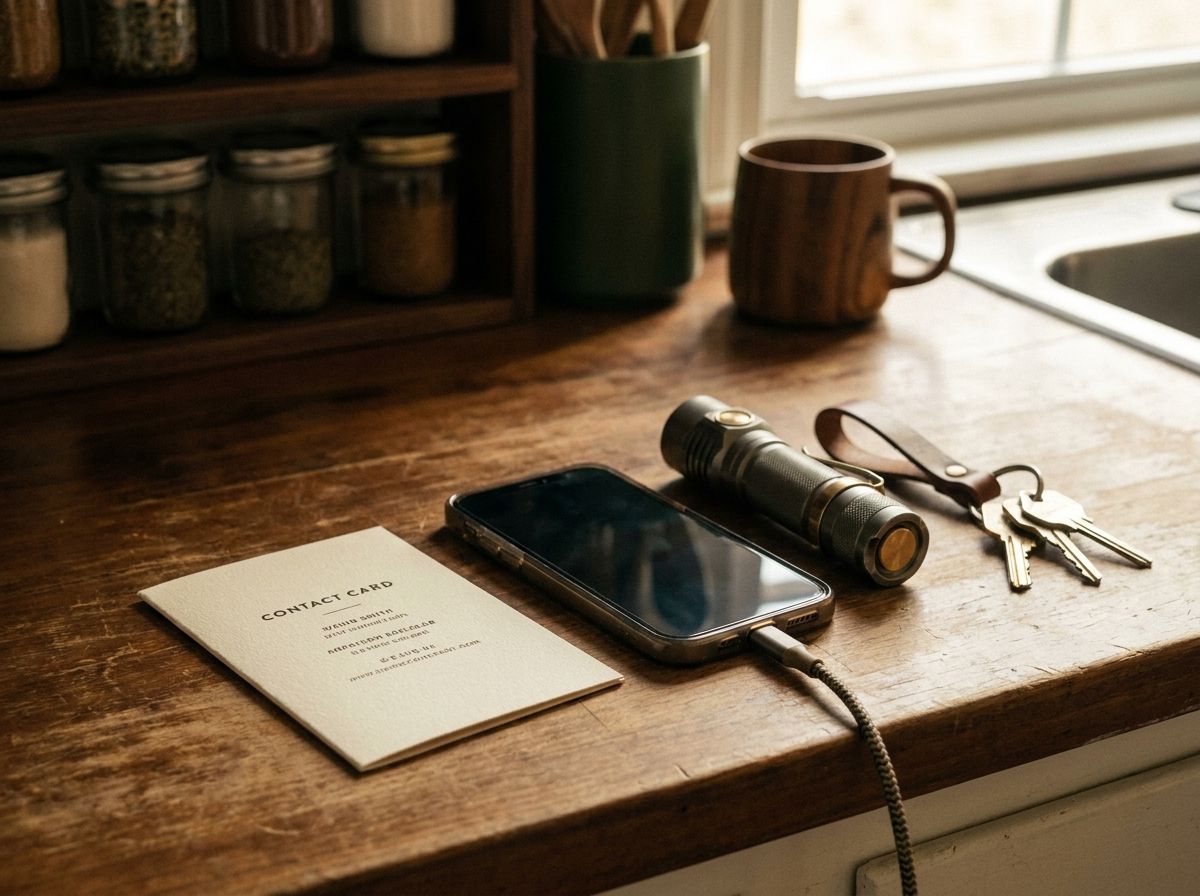
Keep the full version in your document vault or another secure digital location. Print a household copy for a home command spot. Give each adult a small card with key numbers and meeting places. Store a limited version in each vehicle, since a car is often exactly where a disruption begins.
A useful paper layout has four blocks:
- Household: names, mobile numbers, work and school locations
- Contacts: local helper, out-of-area relay, professional numbers
- Places: nearby and outside-area meeting points
- Instructions: check-in message, communication ladder, battery reminder
Use large enough type to read without squinting. Leave space between entries. Black text on white paper beats a decorative design when the kitchen lights are out. Laminate the card or place it in a sleeve, but do not seal it so tightly that you cannot update it.
Protect sensitive data. Do not print account passwords, Social Security numbers, or detailed medical records on the contact card. If a medical detail changes the response, write a brief instruction and store the complete record in your document vault. "Medication list in blue folder" is more appropriate than putting every prescription on a card that could be lost.
Store a digital copy on each adult's phone, but do not rely on a single app. Save the page as a simple file that can open without a special subscription. Take a photo of the printed card only as a backup. A photo is harder to update and difficult to read in low light.
Add the date of the last review at the bottom. That one small line turns a forgotten sheet into something you can actually audit.
Test the list with a short household drill
You do not need a dramatic exercise. A ten-minute drill can show whether the plan holds up. Pick an ordinary moment, Saturday after breakfast works well, and tell everyone that the main phone network is unavailable for the next five minutes. Then ask each person to find the list and explain the next step.
Test these details:
- Can each adult find the paper copy without asking?
- Can each person name the out-of-area relay?
- Can everyone describe the nearby meeting point?
- Does the sample message fit in one text?
- Does the local helper know what action they may be asked to take?
Give the drill a real scenario. "The school closes at 2 p.m. because of a power outage" creates different choices from "we cannot reach the house." Ask who contacts the school, who handles pickup, and where the household checks in. Then change one fact: the usual road is blocked.
When Sam's household ran this test in January, the printed list had an old workplace number and the nearby meeting point was inside a locked building. Nobody had made a major mistake. That was the point. They updated the number, moved the meeting point outdoors, and added the school pickup instruction.
Run the test twice a year and after every major change. The American Red Cross regularly recommends household planning and practice because people recall practiced actions more reliably than written instructions they have only read once. You do not need a perfect simulation. You need enough repetition that the first step feels familiar.
End each drill by asking one question: "What was unclear?" Fix the answer on the page. Do not rely on everyone remembering a conversation that is not written down.
Keep the list current without turning it into a project
A contact list fails through small changes. A child moves schools. A neighbor gets a new number. A workplace shifts buildings. The list stays on the refrigerator, looking official, while the information quietly expires.
Tie the review to a routine you already have. Review it when you rotate seasonal supplies, check smoke alarm batteries, or update insurance documents. Twice a year is enough for most households, but update it immediately after a move, new phone, new school, medical change, or change in custody or pickup permissions.
Use a five-minute audit:
- Call or message each key contact and confirm the number.
- Check every address in a map app and on the printed page.
- Confirm school and workplace procedures.
- Replace damaged cards and remove old copies.
- Read the plan aloud once.
Keep the list short. If it grows to four pages, create a main card and a reference sheet. The main card holds the actions that matter in the first few minutes. The reference sheet can hold utility numbers, insurance contacts, medical offices, and other details.
For households that use Mainstay, the dashboard can serve as the review point for the household profile, document vault, and preparedness plan. You can keep the current digital version there while the printed card stays where people need it. The system does not have to be elaborate. It has to be current.
Your next step is simple. Set a ten-minute timer today, choose the out-of-area relay, write two meeting places, and print a one-page list. Put one copy near the door and one in the car. Then ask someone in the household to find it without help. If they can, the plan has started to work.
FAQ
What should a household emergency contact list include?
Include every household member's full name and mobile number, an out-of-area contact, local emergency and non-emergency numbers, school and workplace contacts, two meeting places with full addresses, and instructions for check-ins and low-battery situations. Add each contact's role so people know who handles school pickup, medical decisions, or other tasks.
How should I choose emergency contacts?
Choose people based on the job they can perform rather than on sentiment. A household contact, local helper, out-of-area relay, and professional contacts may all serve different roles. Ask each person before adding them and explain what you may need them to do.
What communication steps should an emergency plan use?
The article recommends calling the household contact once, sending a short text if the call does not connect, contacting the out-of-area relay, going to the agreed meeting place when the plan says to move, and asking a local helper to confirm a location when safe. Include a short model message and set a specific check-in window instead of requiring constant updates.
How often should I update a household emergency contact list?
Review it after a move, job change, divorce, new school year, or medical change. Phone numbers and other contact details can become outdated without warning, so record two numbers when possible and include a distant contact's city, state, and time zone.
Want this handled automatically? See the Mainstay membership.
Subscribe to comment
Join the Mainstay newsletter to leave a comment — and get new field notes in your inbox.
Get new field notes in your inbox
Practical, calm preparedness — one useful note at a time.