Emergency cash at home: how much to keep and how to store it securely
A practical guide to emergency cash at home, including the right amount, useful denominations, secure storage, and a simple review routine.
At 7:18 on a Tuesday morning, the card reader at the neighborhood gas station went dark. June Wills had enough fuel to get home, but the payment terminal, nearby ATM, and mobile signal were all having the same bad morning.
Emergency cash at home gives your household a quiet backup when electronic payments, bank access, or local power are unavailable. A reasonable starting point is $200 to $500 for many households, adjusted for family size, local costs, medical needs, transportation, and how long you could operate without a working card terminal.
The idea is straightforward: keep enough cash to cover practical short-term purchases, store it in more than one secure location, and track it like any other household supply. A bundle of bills in a drawer is not a plan. It is a drawer with money in it.
Decide what emergency cash is meant to solve
Cash is not a replacement for an emergency fund in a bank or credit union. It is a physical payment tool for a narrow problem: you need to buy something, but the usual electronic route is not working.
That problem can appear during a power outage, a regional internet failure, a storm, a bank service interruption, or a damaged payment network. A store may still have supplies, staff, and a working generator while its card reader is offline. The cashier may accept cash only. Your cash solves the payment problem, not every problem around it.
The Federal Reserve's 2023 Diary of Consumer Payment Choice found that cash remained a regular payment method for U.S. consumers, with consumers using cash for about 16 percent of payments in 2023. That figure matters because cash is still familiar infrastructure. It does not require a charged phone, a password, a signal, or a functioning merchant terminal.
Write down the purchases your household might need during a short disruption. Use realistic local prices, not guesses from a search result.
- Fuel for one vehicle or a transit fare home
- A modest grocery run for perishable food
- Prescription pickup or a pharmacy purchase
- Childcare, pet care, or a local service payment
- A small amount for a neighbor who cannot use a card
- A motel room or roadside expense if travel stops unexpectedly
Now remove expenses that cash would not actually solve. Rent, a mortgage payment, and most utility bills usually require a bank transfer or online account. Do not inflate your home cash reserve because the entire monthly budget looks intimidating. The point is access to a payment method, not recreating your checking account in a shoebox.
Rosa Wills lives in a rural area outside Bozeman, Montana. The nearest fuel station is 18 miles away, and winter travel is not optional. Her household may choose a larger reserve than a household in a dense neighborhood with several stores within walking distance. The number reflects the terrain and the trip, not a universal rule.
How much emergency cash to keep
There is no official dollar amount that fits every household. A useful method is to calculate the cost of a short, cash-only operating period, then add a modest margin without turning the reserve into a tempting target.
Use this formula:
Cash reserve = essential local purchases for 24 to 72 hours + travel or medical buffer.For many households, $200 to $500 is a workable starting range. A single adult who walks to work and lives near several stores may choose the lower end. A household with two vehicles, regular prescriptions, pets, or long travel distances may choose $500 to $1,000. That larger amount should come from a written calculation, not a dramatic headline.
List your likely cash-only costs and assign each one a number. A sample household might record:
- Fuel: $80
- Food and household basics: $120
- Pharmacy or medical copay: $60
- Local transportation: $40
- Pet supplies: $35
- Flexible buffer: $65
That household's target is $400. The exact total will change by location. A gallon of gas in one county may cost much more than a gallon in another, and a prescription copay can vary widely. Check actual prices in your area twice a year.
Household size matters, but it is not the only factor. Add cash when someone depends on medication, a medical device that requires travel or supplies, a long commute, or a regular service provider who accepts cash only. If a household member has mobility needs, include the cost of accessible transportation rather than assuming a quick walk to the nearest store.
Theo Wills keeps a separate $300 reserve because his work requires a 45-minute drive from his home near Tulsa, Oklahoma. His household reserve covers local purchases, while his personal travel buffer covers fuel and a roadside problem. Separating those purposes prevents one trip from quietly consuming the money assigned to the household.
Do not keep so much cash that a theft becomes a household crisis. Insurance coverage may be limited for currency stored at home, and cash usually has no recovery process after it disappears. Review your homeowner's or renter's policy and ask the insurer about currency limits. Your bank or credit union may also have withdrawal limits, so build the reserve gradually if needed.
Choose denominations that work at a counter
The amount matters, but the shape of the reserve matters too. A stack made entirely of $100 bills can leave you unable to pay for a $17 purchase when a store cannot make change. Very small bills are useful, but a reserve made only of ones becomes bulky fast.
Ask your bank or credit union for practical denominations when you withdraw the money. A $400 reserve might include several $20 bills, several $10 bills, some $5 bills, and a small number of $1 bills. Add a few $50 bills only if local businesses commonly accept them. The precise mix depends on your area and the purchases you listed.
Keep the bills clean and flat. Folded or damaged currency can slow down a transaction, especially at a small shop where staff must inspect it by hand. Avoid novelty bills, foreign currency, gift cards, and old checks as substitutes. They may have value, but they do not provide the same dependable payment option.
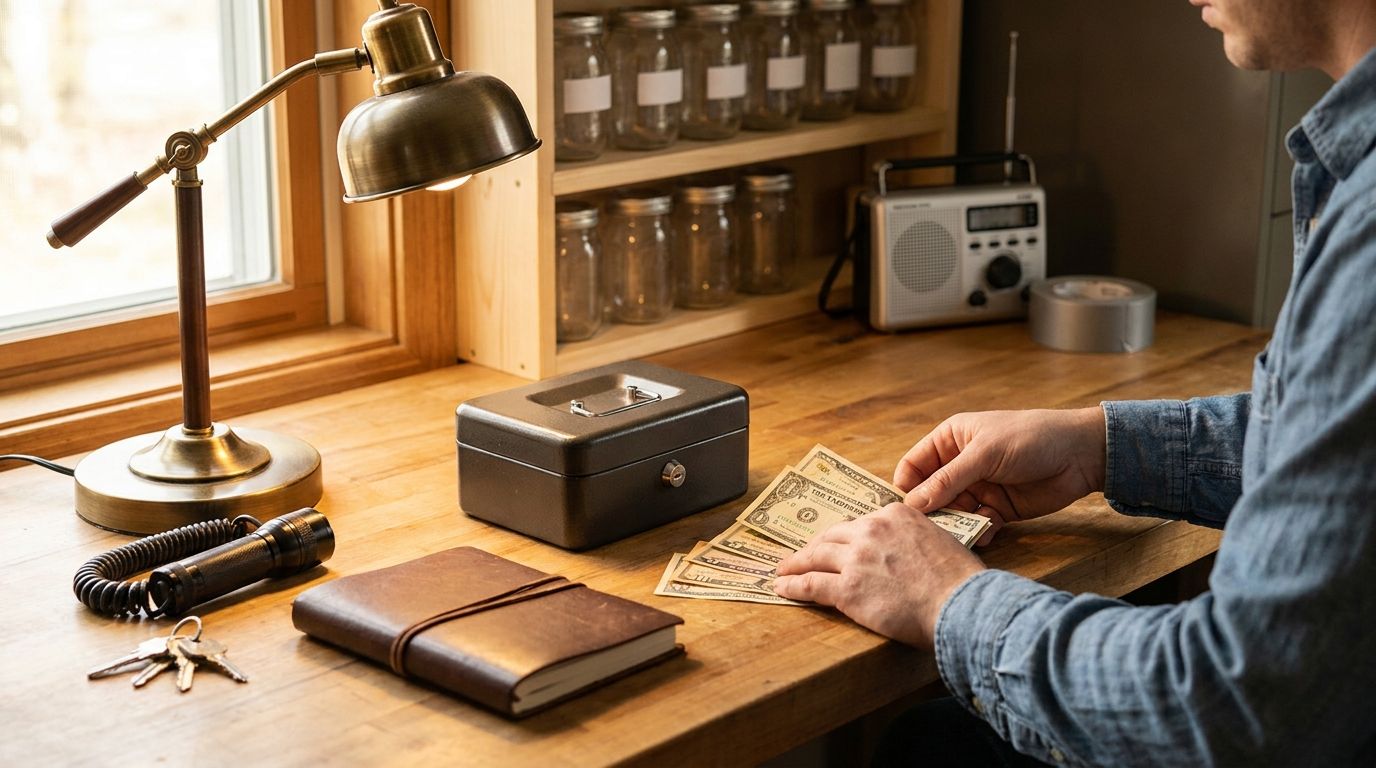
Create a small payment plan beside the cash, but do not write the location on it. Record the total reserve, the denomination mix, the date checked, and the reasons the money is assigned. A simple inventory entry might say:
- Household reserve: $400
- Travel buffer: $300
- Last checked: August 2026
- Replace or review: August 2027
Never write the full amount or exact hiding place on a note visible to visitors. Store the inventory in your household records or document vault, with access limited to the adults who need it. If you use Mainstay's household profile and inventory features, record the reserve as a tracked item with a review date, just as you would record batteries or water containers.
Cash should remain usable. Do not seal bills in a container that takes tools to open, or place the only reserve where a flood, appliance leak, or house fire could destroy it. A little structure beats a clever hiding spot you forget exists.
Store emergency cash at home securely
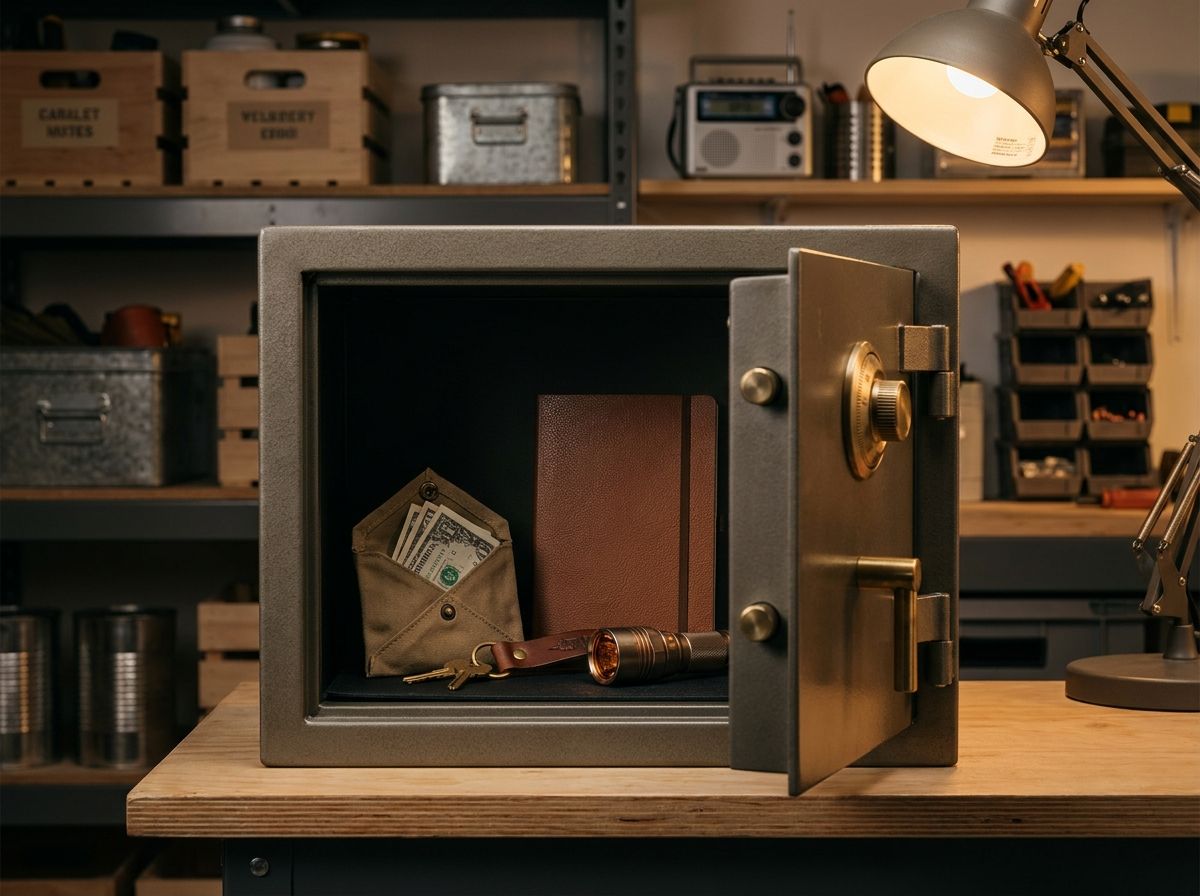
Security starts with two competing needs: the money must be accessible to the right household member, but difficult for a casual visitor, child, contractor, or burglar to find and remove. A locking, fire-resistant safe that is anchored to the structure is usually the strongest home option.
Choose a safe based on its construction and placement, not its marketing label. Look for a model with a tested fire rating, a meaningful water-resistance claim, and a locking system you can operate without a phone or internet connection. Anchor it according to the manufacturer's instructions. A small safe that can be carried away is only a locked container until someone picks it up.
Avoid obvious locations. The top desk drawer, bedside table, kitchen junk drawer, and bedroom closet are common search points. Do not hide money inside food packaging, under a mattress, or in a freezer bag. Those choices are familiar, vulnerable to moisture, and easy to forget.
Use a layered approach:
- Keep most of the reserve in the anchored safe.
- Keep a smaller working amount in a discreet, locked location for quick access.
- Keep the travel buffer separate from the household reserve.
- Protect the inventory record from anyone who does not need access.
- Tell one trusted adult where the primary safe is located and how to open it.
Sam Wills keeps the household reserve in a bolted safe in an interior storage area above the home's known flood level. The location is not secret from the adults in the household, but it is not visible from a window or mentioned on the shopping list. That distinction helps the money stay useful without turning it into household lore.
Moisture deserves attention. Currency can survive ordinary handling, but damp storage creates sticking, staining, and mold. Place bills in a sealed, moisture-resistant envelope or pouch inside the safe, then inspect them during your annual review. Do not vacuum-seal money so tightly that heat or pressure damages it, and do not store it with chemicals, ammunition, or anything that could contaminate it.
If a fire or flood damages the reserve, photograph the condition before handling it and contact your bank for guidance. Do not assume a damaged bill is worthless. Do not attempt to repair it with tape or household chemicals.
Build cash into household emergency preparedness
Emergency cash at home works better when it sits inside a larger household emergency preparedness plan. Your cash cannot help much if nobody knows which adult can access it, where the closest fuel station is, or which documents prove identity after a loss.
Add cash to the same household review that covers supplies, documents, communications, and transportation. The review can stay short. You are checking whether the reserve still matches the household, not writing a financial novel.
Use this practical audit:
- Confirm the total amount and denomination mix.
- Check that the safe opens with the current key or code.
- Verify that the adults who need access still know the procedure.
- Compare the reserve with current fuel, food, pharmacy, and transit prices.
- Check insurance coverage for currency stored at home.
- Update the inventory record and review date.
Think through a few specific moments. If a summer storm takes power across Raleigh, North Carolina, can June buy fuel or groceries without a card reader? If a winter road closure strands Rosa near a rural pharmacy, can she pay for transport? If Sam is away for work, can another adult reach the reserve without searching the whole house?
The answers may show that the cash amount is fine but the access plan is weak. Maybe the safe is in a room that floods first. Maybe only one person knows the code. Maybe the household's cash is all in large bills. Fix the weak point you can actually identify.
Do not share photos of your safe, cash, or storage location online. Avoid discussing the amount casually. Household security includes information security, and loose talk is a surprisingly efficient distribution system.
Review, rotate, and use it when appropriate
Cash does not expire like food, but it does need inspection. Bills can become damaged, the household can change, and your original calculation can stop matching local prices. Set a review every six or twelve months, tied to a date you already remember.
During the review, check the bills, count the reserve, confirm access, and compare your assumptions with current costs. Replace stained or badly worn bills through your bank or credit union. If you borrow from the reserve, record the amount immediately and restore it on your next normal banking trip.
A good reserve should not become untouchable. If you've held the same bills for five years because you are afraid to disturb the setup, the system has become a museum exhibit. You can use the cash for ordinary purchases and replace it with fresh bills, provided the total and denomination plan stay intact.
Keep the money separate from your everyday wallet. Everyday spending can drain the reserve without leaving a clear line between routine use and household backup. A labeled internal account in your inventory system can provide that reminder without labeling the physical container for everyone to see.
Set a trigger for changing the amount, too. Review it after a move, a new prescription, a vehicle change, a job relocation, a new baby, or a major shift in local access to banks and stores. No spreadsheet can predict every disruption, but a dated review catches ordinary changes before they become inconvenient.
Take ten minutes this week. Write down the purchases your household would need if electronic payments stopped working for one day. Price them locally, choose a target, select useful denominations, and store the cash in a locked location that the right adults can reach. Then record the amount and schedule the next review.
FAQ
How much emergency cash should I keep at home?
Many households can start with $200 to $500, then adjust for local prices, household size, transportation, medical needs, pets, and access to nearby stores. Use the cost of essential cash-only purchases over 24 to 72 hours, then add a modest travel or medical buffer. Avoid keeping more than your household can secure and insure responsibly.
Is it safe to keep cash in a home safe?
A fire-resistant safe anchored to the structure is generally more secure than a drawer or loose lockbox. Keep most of the reserve away from obvious search locations, protect it from moisture, and tell the necessary adults how to access it. Check your homeowner's or renter's insurance policy because currency coverage may be limited.
Should I keep emergency cash in small bills?
Yes. A mix of $20, $10, $5, and $1 bills is usually more useful than a reserve made mostly of $50 or $100 bills. Choose the mix based on the stores, fuel stations, pharmacies, and services your household actually uses.
How often should I check emergency cash at home?
Review it every six or twelve months and after a major household change. Count the money, inspect the bills, test safe access, compare current local prices, and restore any amount you used. Record the review date in your household inventory.
Want this handled automatically? See the Mainstay membership.
Subscribe to comment
Join the Mainstay newsletter to leave a comment — and get new field notes in your inbox.
Get new field notes in your inbox
Practical, calm preparedness — one useful note at a time.