How to build a home emergency communication plan when cell service fails
Build a family communication plan that still works when cell service, power, or internet access disappears.
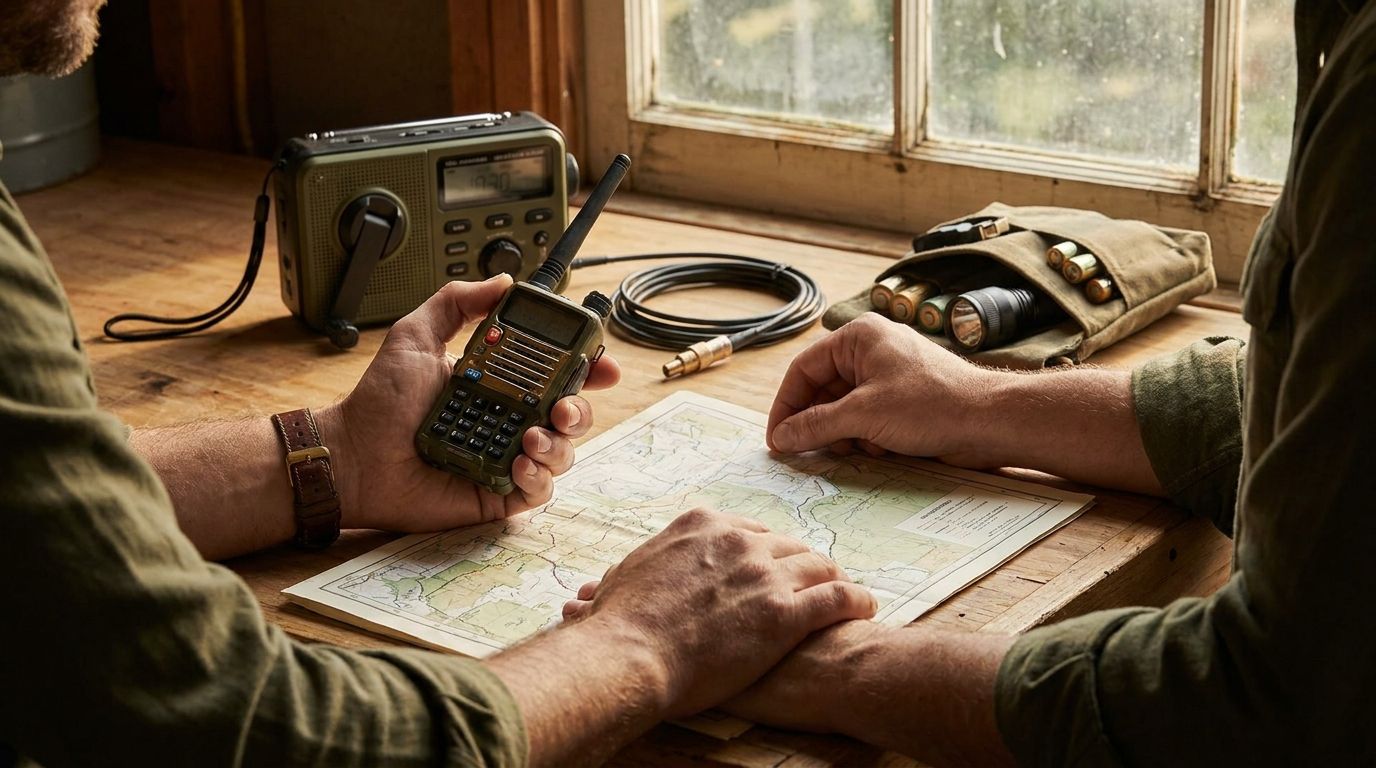
At 6:18 on a Tuesday evening, the Carter household is scattered across Phoenix. One adult is navigating Interstate 17, another is at a grocery store, and the kids are at a community center near Camelback Road. Then a storm knocks out power across several neighborhoods. Phones still light up, but calls won't connect.
A reliable communication plan does not depend on one working cell tower. It gives every household member a short set of actions, a meeting place, an out-of-area contact, and at least one way to get information when mobile service fails. The goal is not constant contact. The goal is a calm way to decide what happens next.
That distinction matters. During a major outage, too many people calling at once can saturate whatever towers are still standing, and the Federal Communications Commission has repeatedly advised keeping emergency calls short and using texts when possible, because texts may slip through on less network capacity.
Start with one simple rule
Your family communication plan should answer one question before the pressure arrives: "If we cannot reach each other, where do we go and who do we contact?" A plan that starts with a dozen apps and a complicated call tree is not a plan anyone will remember under stress. It is a technical manual nobody asked for.
Set a default rule for the household. Something like: if local cell service fails during a serious disruption, each person moves to the assigned meeting place when it is safe to travel, then checks in with the out-of-area contact as soon as a connection becomes available.
Choose two meeting places. One should be close to home - a neighbor's house, a library parking lot, a marked point at the end of the street. The second should sit outside the immediate neighborhood: a relative's house, a workplace, a public building in another part of town.
Use places people can find without an app. "The west entrance of the library" beats a dropped map pin every time. If the meeting place is inside a building, name the specific entrance or an exterior landmark. Skip locations that may close during storms, fires, or flooding.
Write the rule in plain language:
- Go home if travel is safe and the home is usable.
- Go to the nearby meeting place if home access is blocked.
- Go to the farther meeting place if the neighborhood is unsafe or closed.
- Leave a written note only if local guidance says it is safe and practical.
Do not make "everyone calls everyone" the default. That creates confusion and loads the network fast. One household member should act as the communication coordinator, but the plan should work if that person is unreachable. The coordinator keeps the contact list current and confirms information. They are not a single point of failure.
Build the family communication plan around real routines
An emergency contact plan works when it matches the places your household already uses. Start with the weekly calendar, not an imagined disaster map. Mark the home, schools, day-care locations, workplaces, regular sports fields, medical offices, and the routes between them.
The Carter household might list a school in north Phoenix, a workplace near downtown, and that community center near Camelback Road. Their plan has to account for an adult who may be on the road, a child who may be with a program supervisor, and a usual route home that may not be open.
Create a contact card for each household member. Keep the information short enough to read while tired or rushed. Include:
- Full names and common nicknames used by schools or workplaces
- Home address and two meeting places
- Four outside contacts, including one outside the local area
- School, workplace, child-care, and medical phone numbers
- Important allergies, medications, and accessibility needs
- A note about who is authorized to pick up children or pets
Use an out-of-area contact who lives far enough away that the same local outage is unlikely to reach them. A relative in Denver may be more useful to a Phoenix household than a friend across town, their number is one call away but the downed tower is not their problem. That contact can collect updates from separate household members and relay a single clear message back when service returns.
Ask that person for permission before listing them. Confirm their time zone, preferred contact method, and ability to answer during work hours. Then give them the same information you keep at home. A contact who has no idea where the family meets is not much help, even if their number is right.
For children, keep the instructions concrete without placing adult responsibility on them. An adult can tell a child: "Stay with your teacher or the designated supervisor. Do not leave with anyone unless the approved pickup process confirms it." The exact wording should match the school or program's own rules.
Pets need a place in the plan too. Scout may be at home, in the yard, or with a sitter when the disruption starts. Record the sitter's number, the pet's usual hiding spot, and who can transport the animal. A plan that forgets the dog usually reveals other gaps as well.
Decide what to do if cell service fails
The phrase "cell service failed" can describe several different problems. Your phone may have power but no signal. The local network may be overloaded. Your carrier may be down while another carrier still works. Internet may be out even though voice calls connect. Each condition calls for a different backup.
Use a communication ladder rather than one preferred method. Move down the ladder when the previous step fails:
- Send a short text before making repeated calls.
- Try Wi-Fi calling or a household internet connection if both remain available.
- Use a landline, office phone, school phone, or another carrier's phone.
- Listen to a battery radio or vehicle radio for official instructions.
- Travel to the assigned meeting place only when routes are safe and authorities have not restricted movement.
A text should carry the useful facts in one message: who you are, where you are, whether you are safe, and what you will do next. "Safe at Mesa Library. Going to west entrance at 7:00. No reply needed" is better than "Call me." It cuts back-and-forth traffic and gives the recipient a clear status. Simple.
If you make a voice call, keep it brief. State your location, condition, and next step. Do not keep redialing a busy network every few seconds, it drains your battery and does not improve the odds of getting through.
Use 911 for an immediate threat to life, serious injury, fire, or another situation that needs emergency services. Do not use it as a general information line. For updates, monitor local government alerts, weather radio, official websites when available, and instructions from your school or workplace.
The Federal Emergency Management Agency recommends receiving alerts through more than one channel. Wireless Emergency Alerts can reach compatible phones, but they are not a complete household communication system. They do not tell your family where to meet, who has picked up a child, or whether the dog is still at the house.
Test every method before you rely on it. A battery radio with dead batteries is furniture. A printed number stored in a drawer nobody opens is a small paper coaster.
Write the home emergency communication plan
Put the plan on one page. Keep the language direct, and write actions in the order someone should take them. You are building a decision tool, not a family history.
Include these sections:
- Trigger: what happened, and what conditions activate the plan?
- Status: how does each person report safe, injured, delayed, or unable to travel?
- Location: where does each person go if home, school, or work is unavailable?
- Contact: who receives updates when local communication is limited?
- Timing: when does the household check in or move to the next step?
- Authority: which official sources should guide evacuation, sheltering, or road decisions?
A useful trigger might be "local cell service has failed for 30 minutes during a power outage" or "a school, workplace, or public safety agency has directed people to leave." Avoid vague wording like "when things get bad." People will interpret that differently, especially when they are tired and the lights are out.
Set check-in times that do not require constant messages. The Wills household, for example, could use 7:00 a.m., noon, and 7:00 p.m. as planned windows during a prolonged outage. A missed check-in activates the next step rather than a frantic stream of calls.
Give each person a paper copy. Keep one in the home document file, one in each vehicle, and one with everyday carry items. A digital copy can live in the document vault or on a phone, but paper matters when batteries, passwords, or internet access become problems.
The plan should also state what not to do:
- Do not travel into a restricted area to look for someone.
- Do not leave a workplace or school without following its release procedure.
- Do not share private medical or location details on public social media.
- Do not assume silence means danger; the network may simply be unavailable.
Review the page with every adult and older child in the household. Ask each person to explain the plan without looking at it. If the explanation sounds different each time, edit the plan until the words are easier to remember.
Add communication tools without creating clutter
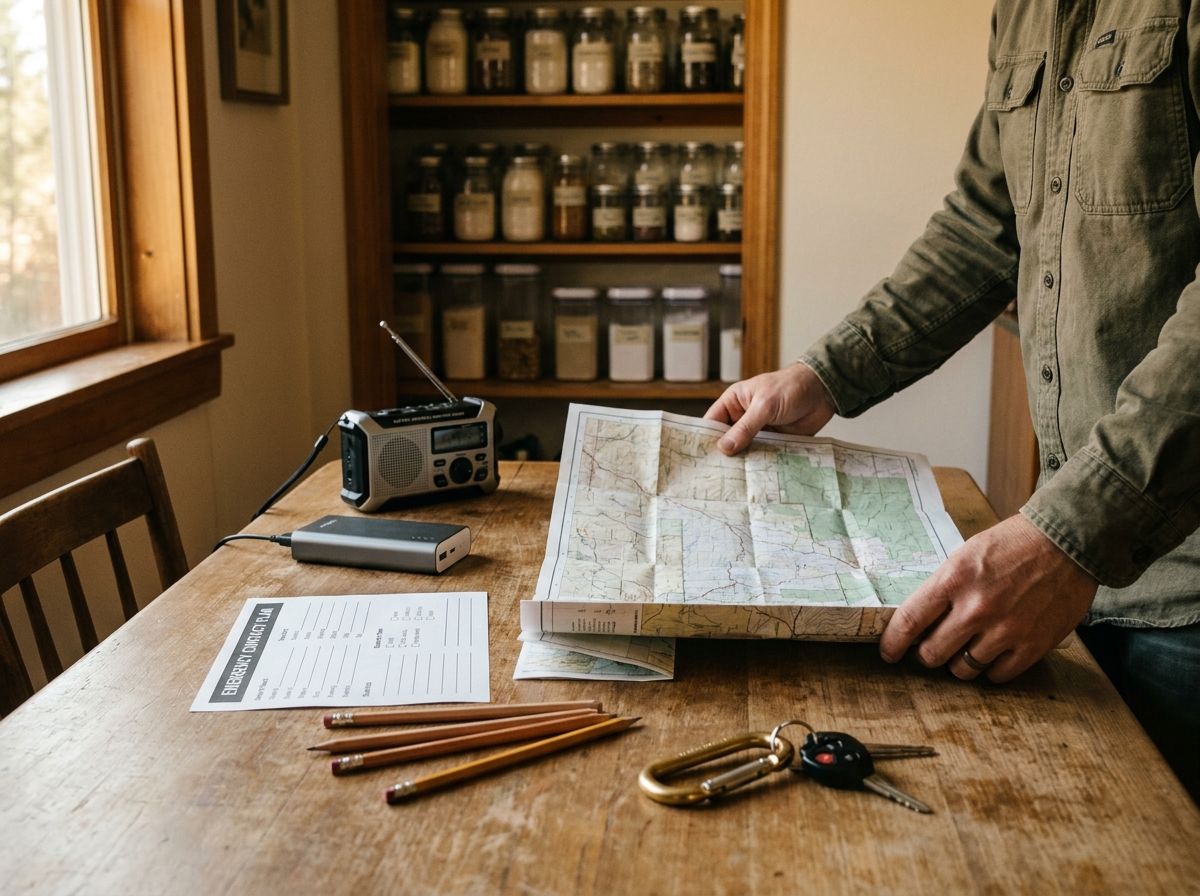
A home emergency communication plan needs a few dependable tools, not a room full of gadgets. Start with what the household already uses during an outage: charged phones, vehicle chargers, power banks, a battery or hand-crank radio, and printed contact cards.
Keep the communication kit somewhere everyone can find it. The entryway cabinet often works better than a locked office drawer because people pass it on the way out the door. Store the radio, spare batteries, charging cables, paper maps, pencils, and copies of the plan together in one labeled container. Something plain like "household communication" is enough.
Check these details every month:
- Phone power banks still hold a charge.
- Radio batteries are present and within their usable date.
- Charging cables match the devices in the household.
- Printed phone numbers and addresses are current.
- The paper map still shows useful roads and meeting places.
A landline may work during some outages, but cordless handsets usually need household power to function. If you have a corded phone and an active landline, test it. Do not assume it works because the wall jack is still there.
Amateur radio can provide a useful option for trained operators, but it is not a plug-and-play household solution. It requires equipment, licensing where applicable, practice, and a local network. Treat it as an added skill rather than the primary answer.
Satellite messengers and satellite phones can work beyond ordinary cell coverage, but they need clear sky access, charging, subscriptions, and practice. They may make sense for remote travel or work, while a paper plan and radio remain more practical for most homes.
With Mainstay's inventory and household profile, you can record where the communication kit lives, which items need charging, and who needs access to the plan. The point is not to collect equipment. The point is to know what works, where it is, and when you last tested it.
Practice the plan under ordinary conditions
A family communication plan is only useful if people can follow it without a group text explaining every line. Run a short drill on a quiet weekend. Keep it low-key. Turn off the home Wi-Fi for 20 minutes, put phones in another room, and ask everyone what they would do next.
Use realistic scenarios. On a Friday afternoon in Columbus, one adult may be at work, one driving on U.S. Route 23, and a child at an after-school program. Ask where each person goes, who receives the update, and what happens if the nearby meeting place is closed.
Try a second scenario at night. Power is out, local roads are wet, and the radio reports a wide outage. Can someone find the printed plan without using a phone flashlight? Can each adult locate the radio and spare batteries? Can the household identify which official source covers road conditions?
After the drill, record what failed. Common problems include:
- A meeting place is inside a building that closes early.
- The out-of-area contact changed phone numbers.
- Nobody knows whether a child should wait at school or travel independently.
- The radio works, but nobody knows which station carries local updates.
- A vehicle charger is missing from the car where it belongs.
Fix one or two problems immediately. Then repeat the drill after a season changes, a child changes schools, a household member changes jobs, or someone moves. The National Weather Service encourages households to make communication plans before severe weather arrives, and the same logic applies to outages caused by other hazards.
Keep the tone matter-of-fact. A drill is a test of the system, not a test of anyone's nerve. If the plan is awkward, that is useful information. You found the weak spot while the kitchen was still dry and the coffee was still hot.
Review, store, and improve the plan
Set a recurring review on the same schedule as your supply checks. A quarterly review works for most households, with an extra update after a move, new job, school change, medical change, or major purchase.
During the review, verify every number by actually calling or messaging the contact when normal service is available. Confirm meeting places in person. Check whether construction, new access rules, seasonal flooding, or changed work schedules affect the route.
Keep the current version in four locations:
- A visible household binder or document file
- Each vehicle used by the household
- A secure digital location available without a data connection
- With the out-of-area contact
Write the revision date on every paper copy. Remove old copies rather than stacking new pages on top of them. Conflicting versions create avoidable arguments at exactly the wrong moment.
Protect sensitive information. A communication card needs enough detail to help the household, but it does not need every account number, password, or private record. Store medical and legal documents separately with appropriate protection. The contact plan should help people coordinate without becoming a complete identity file.
Use your dashboard or calendar to set reminders for the review, radio check, battery check, and contact confirmation. The work is small when it is spread across the year. It becomes unpleasant only when nobody looks at the plan until a storm is already at the door.
Your next step is simple: write down two meeting places and one out-of-area contact today. Then send that contact a short message asking whether they agree to serve in the role. You can build the rest of the emergency contact plan around those two decisions.
FAQ
What should I do if cell service fails during an emergency?
Send one short text with your location, safety status, and next step. Then use the household's communication ladder: Wi-Fi calling, a landline, a radio, or a safe meeting place. Avoid repeated calls unless someone faces an immediate threat.
What belongs in a family communication plan?
Include meeting places, household contact details, an out-of-area contact, school and workplace information, medical needs, pet instructions, check-in times, and official information sources. Put the plan on paper as well as storing a digital copy.
How can my family communicate without phones?
Use a battery radio for official updates and follow the written meeting plan. A landline, workplace phone, school office, or another carrier's phone may work when your usual mobile connection does not. Travel only when routes are safe and official instructions allow it.
How often should I update an emergency contact plan?
Review it at least once each quarter and after a move, job change, school change, new medical need, or change in meeting location. Confirm contact numbers instead of assuming they remain current.
Should I use an out-of-area emergency contact?
Yes. An out-of-area contact may be outside the local network failure and can collect updates from several household members. Ask permission, share the written plan, and make sure they know the meeting places and check-in schedule.
Want this handled automatically? See the Mainstay membership.
Subscribe to comment
Join the Mainstay newsletter to leave a comment — and get new field notes in your inbox.
Get new field notes in your inbox
Practical, calm preparedness — one useful note at a time.