How to build a household reorder point system for emergency supplies
Stop discovering empty batteries and expired medicine at the wrong moment. Build a simple reorder point system that keeps household supplies current.
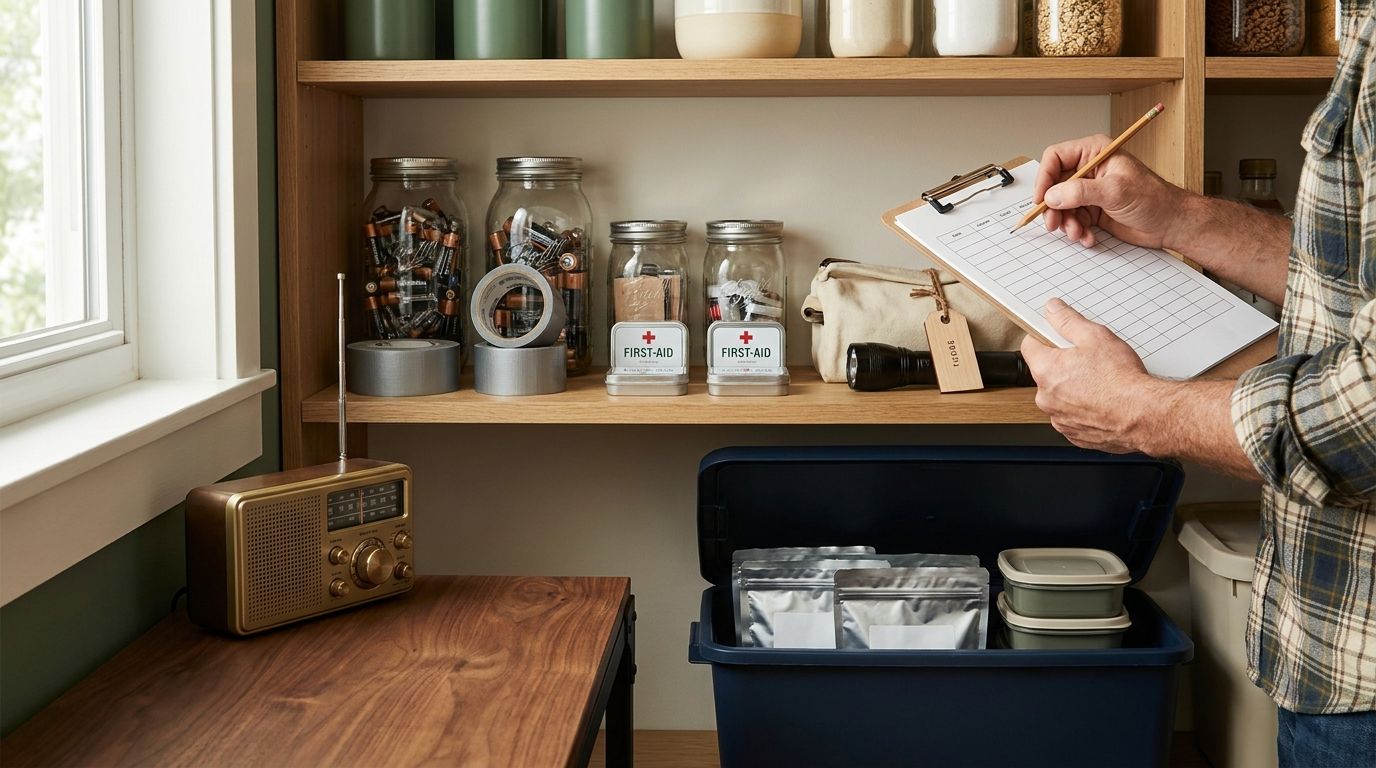
The kitchen cabinet was open, the flashlight was on the counter, and the last two AA batteries were already spoken for. A quick power outage had turned a small supply gap into a household debate about which remote could wait. Emergency supply reorder points prevent that scramble by telling you when to buy, rotate, or replace an item before it becomes the last one on the shelf.
A useful system does not require a warehouse, a spreadsheet obsession, or a heroic Saturday afternoon. You need a household inventory system, a realistic estimate of how quickly your supplies disappear, and a clear trigger for preparedness supply restocking. The goal is simple: your emergency kit maintenance happens during an ordinary shopping trip, not during a stressful event.
The best reorder point is not the lowest possible quantity. It is the quantity that gives you time to act while preserving enough supply for your household's actual needs.
What a reorder point actually does
A reorder point is the minimum quantity you want on hand before you purchase more. It is different from a target quantity. The target is where you want your stock to land after shopping. The reorder point is the signal that tells you to move.
Here is a concrete example. A household might want 24 liters of stored drinking water but set its reorder point at 12. When the count hits 12, they buy enough to return to 24. That gap creates room for ordinary use, delivery delays, and the occasional forgotten shopping trip.
This distinction matters because supplies leave the house at different speeds. Batteries may sit untouched for months, then disappear during a weekend of device testing. Pet food follows a steady schedule. Prescription medicine has refill rules and legal limits that shape how much you can keep on hand. A single blanket rule will fit none of these very well.
A practical reorder point answers four questions:
- What item are you tracking?
- How many usable units do you have today?
- How quickly does your household use the item?
- How much time do you need to buy or replace it?
The simplest formula is:
Reorder point = expected use during the buying window + a reserve for delays or unusual demand.If your household uses four cans of a particular food each month and you shop every two weeks, the buying window is about two cans. Add four cans as a reserve, and your reorder point is six. Your target could be twelve cans, depending on storage space and how central that food is to your household plan.
This is not an exercise in predicting the future. It is a way to make a calm decision with the information you already have, replacing memory with a visible rule. Memory becomes remarkably unreliable near an empty shelf.
Set emergency supply reorder points by category
Do not give every supply the same threshold. A household supply system works better when each category has its own rhythm, storage limits, and replacement concern.
Start with categories that affect health, water, communication, food, sanitation, and basic comfort. Then divide each into consumables, durable equipment, and documents or information. Consumables need quantity tracking. Durable equipment needs condition checks. Documents need access dates and update dates.
Use a separate decision for each category:
- Water: Track usable containers, not just gallons written on an old note. Set a minimum based on household size, local guidance, pets, and the length of time your plan covers.
- Food: Count meals or servings your household will actually eat. Track allergies, special diets, cooking needs, and expiration dates.
- Medication and first aid: Track doses, critical items, and expiration dates. Follow prescription rules and ask a pharmacist about safe refill timing.
- Lighting and power: Count working flashlights, lanterns, batteries, charging cables, and fuel where relevant.
- Sanitation: Track soap, disinfectant, waste bags, paper products, and personal care items according to normal household use.
- Pet supplies: Include food, medication, waste bags, carriers, and water needs. Scout's food should not be an afterthought simply because it lives in a different room.
The category approach also prevents a common mistake: buying more of what feels dramatic while ignoring ordinary items that keep a household functioning. A spare radio is useful. So is enough toilet paper to avoid turning a minor disruption into a memorable one.
You can keep one master inventory, but each category should have a clear owner or check date. If everyone assumes someone else is tracking water filters, nobody is tracking water filters. Put the responsible person and the review month beside the category.
For each item, record a small amount of information:
- Item name and size
- Current quantity
- Target quantity
- Reorder quantity
- Expiration or replacement date
- Storage location
- Last checked date
That is enough to make the list useful without turning it into a second job.
Calculate a realistic minimum and target
The most reliable household inventory system starts with actual use rather than imagined consumption. Look at the past 30 to 60 days and count what your household bought, opened, or replaced. No records? Use one month as a starting estimate and label it as such.
Suppose Rosa Wills checks the kitchen and finds that her household goes through two bottles of dish soap, one package of batteries, four cans of beans, and one 12-pack of bottled water in a normal month. Those numbers are not automatically emergency quantities. They are clues about household demand and replacement speed.
Now add the buying window. If the household shops weekly, the window may be seven days. If an item comes from a specialty store, takes a week to ship, or is often unavailable locally, use a longer window. Add a reserve for anything where a shortage would create a health or safety problem.
A basic worksheet can look like this:
| Item | Monthly use | Buying window | Reserve | Reorder point | Target |
|---|---|---|---|---|---|
| Batteries | 1 pack | 0.5 month | 2 packs | 3 packs | 6 packs |
| Dish soap | 2 bottles | 0.25 month | 1 bottle | 2 bottles | 4 bottles |
| Pet food | 1 bag | 0.25 month | 1 bag | 1.25 bags | 3 bags |
| Canned beans | 4 cans | 0.5 month | 4 cans | 6 cans | 12 cans |
The numbers do not need false precision. Round up to a whole package, especially when partial quantities are awkward to store or use. You also need to account for shelf life. A target of 40 cans is not sensible if your household has room for only 20 and rarely eats canned food.
Set a reorder point lower for easy-to-buy items with stable availability. Set it higher for items that are expensive, seasonal, medically important, or difficult to replace. A regional winter storm may make bottled water, batteries, and propane harder to find, but that does not mean you need to buy a year's supply. It means your buying window may be longer during certain months.
Review the numbers after one month. If you are constantly ordering too late, raise the point. If supplies pile up and expire, lower the target or slow the buying cycle. The system should describe your actual household, not an imaginary one with unlimited storage and perfect discipline.
Build the tracking method you will actually use
A reorder system fails when checking it takes longer than the task it is meant to support. Choose the method that fits how you already manage the home. A paper sheet inside a cabinet can work. A shared phone note can work. A spreadsheet can work. A household platform can work when you want inventory, documents, and plans kept in one place.
The format matters less than the information. Every method should show what you have, what you want, and what action is due. Use plain labels like "buy," "rotate," "test," and "review." Avoid codes that require a second document to interpret.
A practical check can follow this sequence:
- Pull the item forward so hidden stock is visible.
- Count usable units, excluding damaged or expired items.
- Compare the count with the reorder point.
- Mark the action: buy, rotate, replace, or no action.
- Add the date and note any reason the number changed.
A label on the shelf can cut mental effort significantly. Write the target and reorder point on a removable card, something like "Target 12, reorder at 6." For dated supplies, place the oldest usable item at the front. This supports a simple rotation habit rather than a dramatic annual cleanout.
A dashboard can help you see which categories need attention, while an inventory record gives you the details. Mainstay can help you keep your household profile, inventory, preparedness plan, and document vault current in one place. You still need to count the supplies, but the record makes the next action easier to find.
Keep the check connected to a routine you already perform. Review food and sanitation after the weekly grocery trip, check power supplies on the first Saturday of each month, and review documents twice a year. The exact schedule is less important than having a repeatable cue.
Do not try to inspect every item every week. High-use items deserve frequent checks. Stable items can run on a monthly or seasonal rhythm. Your household is allowed to use a light touch where a heavy system would collapse from neglect.
Add expiration dates and replacement rules
Quantity alone is not enough. An unopened item can still be unsuitable if it is expired, damaged, contaminated, or no longer compatible with your equipment. Emergency kit maintenance needs a condition rule beside the quantity rule.
For food, use the date as one signal rather than the only signal. Follow the manufacturer's storage guidance, inspect packaging, and store items away from heat, moisture, and pests. A dented can with a compromised seam does not belong in your usable count. If you would not serve it on an ordinary Tuesday, do not count it as a dependable emergency meal.
For batteries, test devices and inspect for swelling or leakage. Replace batteries that show damage. And keep battery types matched to the equipment you own, because a pile of the wrong size is just a small plastic monument to optimism.
For water containers and filters, record the fill date, filter life, storage conditions, and manufacturer's replacement guidance. For medications, use the expiration date and pharmacy guidance, and do not adjust a prescribed regimen just to make an inventory number work.
Give each item one of four statuses:
- Usable: Count it toward the current quantity.
- Use soon: Move it into normal household use and replace it on the next shopping trip.
- Replace: Remove it from the usable count and buy a new unit.
- Inspect: Set a specific task, such as checking a seal, testing a device, or confirming compatibility.
This status system keeps old supplies from hiding inside a reassuring total. It also makes rotation practical. Use the oldest food in regular meals, then replace it with a newer item at the target quantity. Test a flashlight during a monthly check, not only when the room goes dark.
The Federal Emergency Management Agency encourages households to maintain basic supplies and review plans. Maintenance is where that advice becomes useful. A kit is not a finished object; it is a set of items that age, move, and get used.
Plan for disruptions without overbuying
A reorder point should reflect the disruption your household is most likely to face, not the most alarming headline you have read recently. A winter storm, wildfire smoke, hurricane, water interruption, or extended outage may change what you need and how quickly you can replace it.
Use your local weather outlook or official local alerts to identify seasonal pressure points. If snow regularly closes roads near your home, raise the reorder point for food, medication, pet supplies, and heating-related items before winter. If summer storms interrupt power, check batteries, charging equipment, water, and refrigerated food plans before storm season begins.
Keep a temporary seasonal adjustment separate from your permanent baseline. Theo Wills, for example, might keep a normal target of six battery packs but raise it to eight from November through February because local roads can close for several days. When winter ends, he returns to six rather than letting every seasonal purchase become a permanent fixture.
Your adjustment list might include:
- Local weather patterns and road access
- Delivery times for specialized supplies
- Household members' health or mobility needs
- Pet care requirements
- Planned travel or home renovation
- Storage limits and safe temperatures
Avoid treating every possible disruption as a reason to buy more. A useful plan identifies what changes, by how much, and for what period. Write the start and end dates for the seasonal adjustment. Otherwise, a temporary increase tends to become a permanent pile in the garage.
You can also use a small "next trip" list rather than placing an order every time an item crosses the threshold. Group low-priority replacements with ordinary shopping. Buy critical items sooner when delay would create a meaningful gap. That is the difference between a reorder signal and a panic purchase.
The system should lower noise. If every headline reshapes your inventory, you do not have a plan, you have a household reacting to headlines.
Test the system with real household scenarios
A system earns trust when it works on an ordinary day. Test it with a few situations that resemble your actual household rather than a theoretical supply exercise.
Imagine a Tuesday in March. June Wills checks the cabinet and finds five cans of the beans her household uses regularly. The reorder point is six, so the action is clear: add enough cans to return to the target of twelve. She does not need to rebuild the entire pantry or buy food nobody eats.
Now consider a short power outage in Boise, Idaho. The household uses three AA batteries to replace dead cells in a lantern and a radio. The inventory count drops from six packs to five, while the reorder point is four. No purchase is required yet, but the check records the use. If another pack is used before the next shopping trip, the buying signal appears before the shelf is bare.
A third example involves medication. A household member has a prescription with a limited refill window. The reorder point cannot be based only on a preferred number of bottles, the household also records the next eligible refill date, checks storage conditions, and contacts the pharmacy early enough to resolve a delay. The inventory rule supports the medical process; it does not replace professional guidance.
Run your own test with these prompts:
- What happens when one item is used unexpectedly?
- What happens when a delivery takes twice as long?
- Who notices the low count?
- Where is the replacement recorded?
- What gets removed from the usable total?
If the answer requires someone to remember a detail that lives only in their head, improve the record. If the answer requires searching through four boxes, improve the storage location. If the answer is "we will notice eventually," set a check date.
A good reorder point system is boring in the best way. It gives you a small, visible task while the situation is ordinary. That is the whole advantage.
FAQ
How often should I check household emergency supplies?
Check high-use or health-related supplies monthly, and inspect low-use equipment at least quarterly. Add seasonal reviews before weather patterns that affect your area. A quick count is more useful than a large annual audit that keeps getting postponed.
What is a good reorder point for emergency food?
Set the point using normal household consumption, the time needed to shop, and a reserve that fits your storage space. Count food your household will actually eat, then review the number after a month. Adjust the target when food expires faster than your household can rotate it.
Should I track emergency supplies in a spreadsheet?
A spreadsheet is useful if you will open it and update it. A paper list, shared note, or household inventory platform can work just as well when it shows current quantity, target quantity, reorder point, dates, and location. The best tool is the one that stays current.
How do I handle supplies that expire?
Use the oldest usable items first, inspect packaging and storage conditions, and remove anything damaged or unsuitable from the count. Mark items as "use soon" before they become expired. Replace critical supplies immediately rather than waiting for a full scheduled audit.
Should seasonal reorder points replace my normal baseline?
No. Keep a normal baseline and add a dated seasonal adjustment when local conditions justify it. Record when the adjustment starts and ends so a temporary increase does not quietly become permanent storage clutter.
Set up one category today. Count what is usable, write down the target, and choose the reorder point. Then put the next review date on your calendar. A household stays current through small decisions made on time, not through one perfect inventory day.
Want this handled automatically? See the Mainstay membership.
Subscribe to comment
Join the Mainstay newsletter to leave a comment — and get new field notes in your inbox.
Get new field notes in your inbox
Practical, calm preparedness — one useful note at a time.