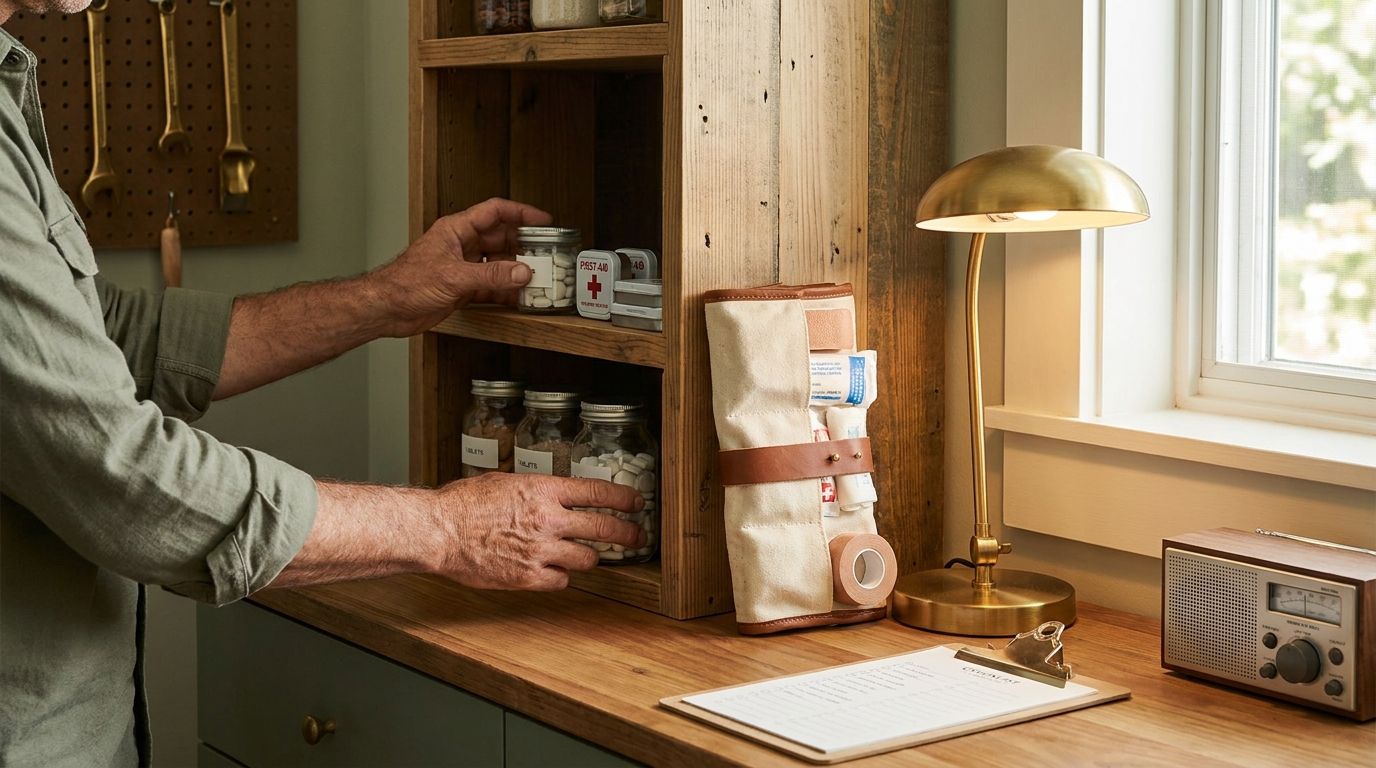
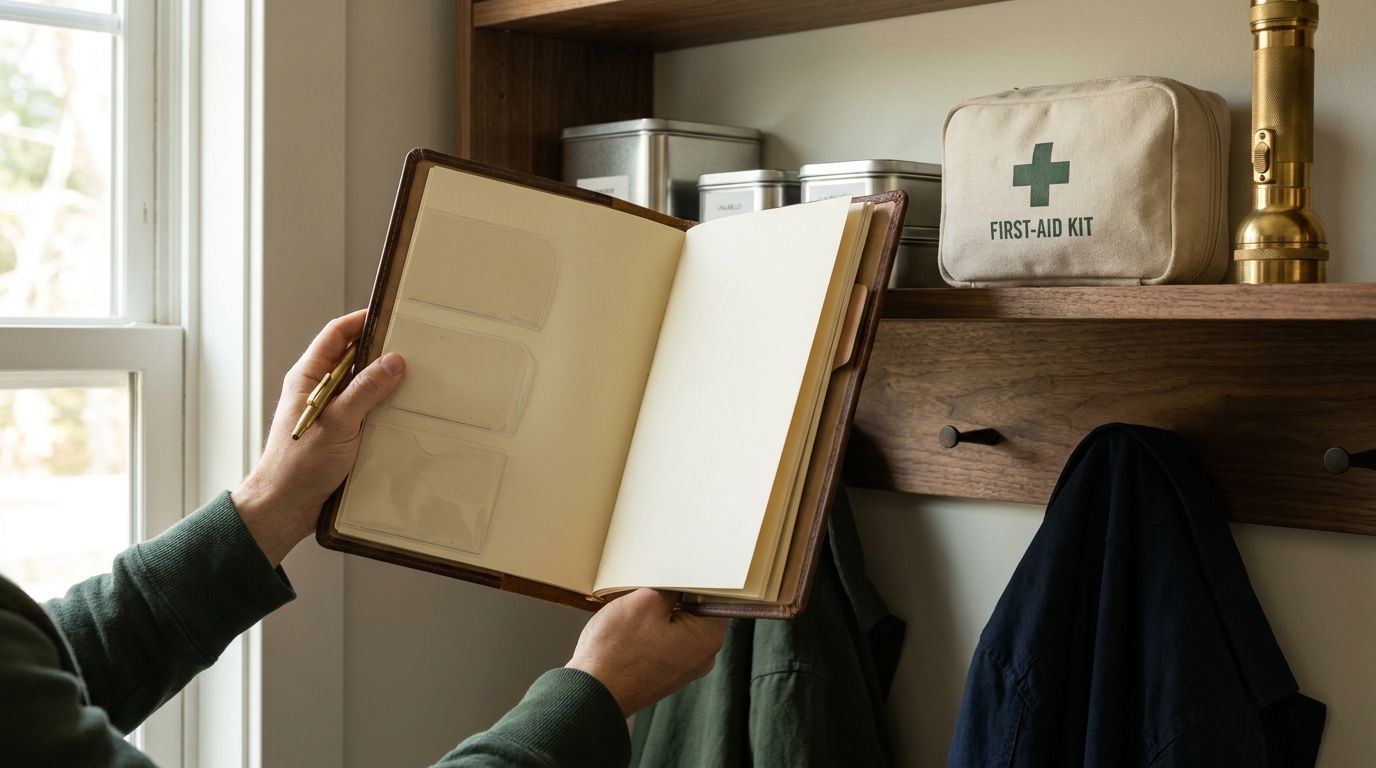
How to label emergency supplies so anyone can find them
Good emergency supply labels turn a crowded closet into a usable household system. Learn what to label, where to place it, and how to keep it current.
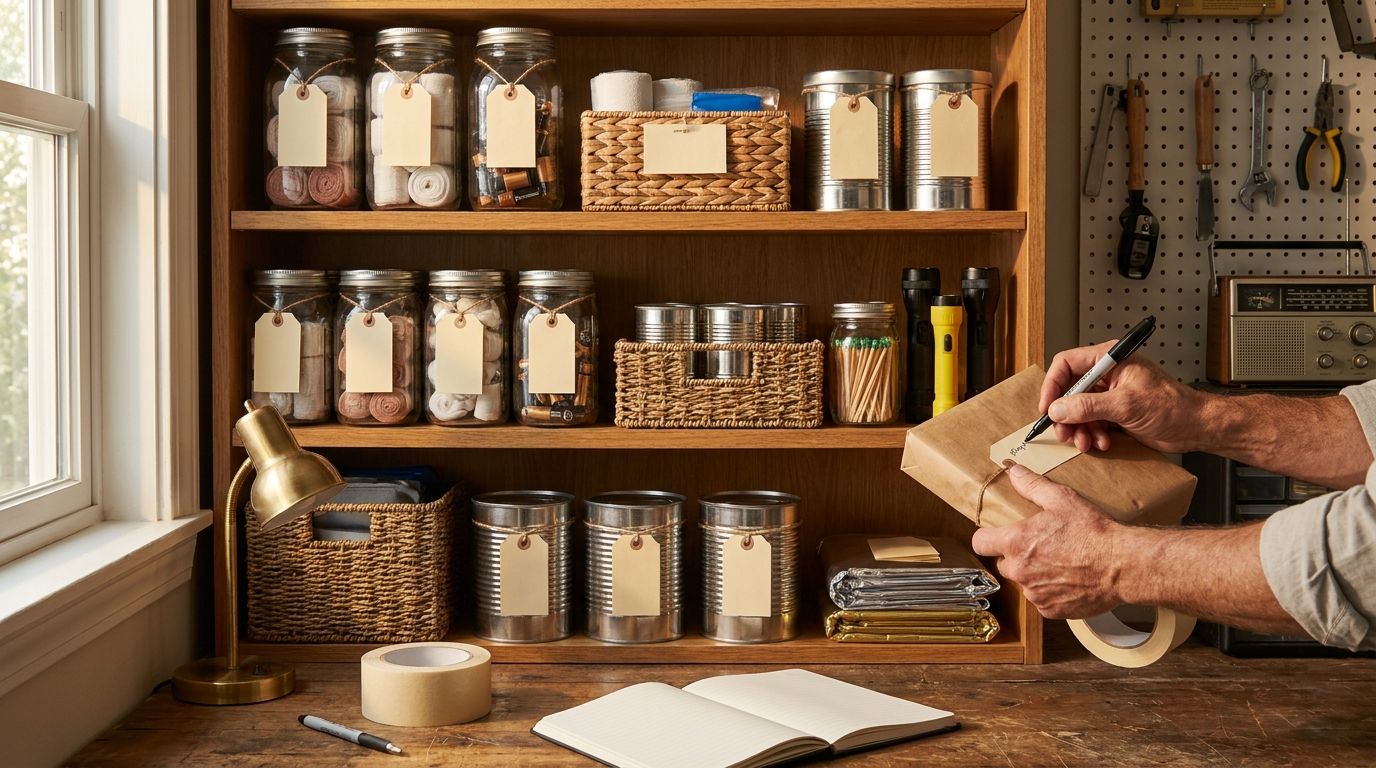
At 10:40 p.m. on a January night in Boise, the power goes out. The house is dark, the refrigerator is quiet, and someone needs the flashlight. You know it's in the hall closet. You do not know which of the six identical plastic bins contains it.
That small problem is the whole point. Emergency supply labels should help any person in your household find the right item without asking you, opening every container, or squinting at a handwritten note from three years ago. The best labeling system uses plain words, large print, consistent locations, and enough detail to support action under stress.
You do not need a color-coded warehouse or a wall of laminated charts. You need labels that answer four questions quickly: What is in here? Who is it for? When does it expire? What should I do with it?

Start with the person who is looking, not the person who packed it
You may know your supplies by memory. Your household should not have to borrow that memory from you. A label works when a tired adult, a visiting relative, or a teenager who has never touched the closet can find the correct item without a guided tour.
Walk through your home and imagine you're seeing the storage area for the first time. A label reading "miscellaneous" tells you almost nothing. "Power outage: lights and charging" gives you a useful decision. "Water" beats "blue bin," because bins move and colors disappear under poor lighting.
Use the words your household already uses. If everyone calls the basement cabinet the utility shelf, label it that way. If you store supplies in a mudroom, skip formal terms like "resilience cache" that sound like they came from a committee meeting.
A practical label answers the next question before someone has to ask it. For example:
- "Flashlights and headlamps" identifies the contents.
- "Use first" identifies priority.
- "Replace after opening" gives an action.
- "For Scout" or "Pet supplies" identifies the intended user.
The Federal Emergency Management Agency recommends that households keep key supplies accessible and consider the needs of everyone in the home, including pets. Accessibility is not only about shelf height. It is also about recognition. A clearly named box is easier to use than a perfectly stocked box with a vague label.
Test your labels with someone who did not organize the supplies. Ask them to find a flashlight, a first aid item, and water treatment supplies. Don't help right away. If they pause at the same bin every time, your system has found its weak point. That is useful information, not a personal failure. (Storage systems are surprisingly good at exposing our assumptions.)
Choose a small labeling language and use it everywhere
Organize emergency supplies with a limited set of terms. That language should stay consistent across bins, shelves, drawers, and digital records. When every container uses a different naming style, your household spends time translating instead of locating.
Pick category names based on use. Strong categories include power, water, food, first aid, sanitation, communication, warmth, tools, documents, and pet care. Adjust the names to fit your home, but avoid creating a new category for every object.
A label on the front of a bin should usually carry four elements:
- The main category in large print.
- The most important contents in smaller print.
- A priority or use note when needed.
- A review date or expiration note when supplies can age.
A food tote might say "Food: ready-to-eat meals, snacks, can opener. Review October 2027." A power bin might say "Power: batteries, chargers, extension cord. Test batteries before use." Both are more useful than a label that simply says "Emergency kit."
Use the same category name in your household inventory. If the shelf says "Water," the inventory should not call it "hydration assets." Mainstay can help you keep an inventory and household plan current, but the physical label still has to make sense when the internet is down and your phone battery is low.
Avoid codes that only one person understands. A label like "B-4" might connect to your spreadsheet, but it does not help a neighbor locate a lantern. Codes can support a system, they should not replace plain language.
Keep abbreviations to familiar ones. "CO detector" is clear to most adults, while invented shorthand creates hesitation. You are trying to remove decisions, not design a tiny household puzzle.
Label the storage location before labeling every item
A common mistake is to put detailed labels on individual packages while leaving the shelves and bins unnamed. That approach helps only after someone has already opened the container. Start with the broad location, then add detail where it improves use.
Think in layers. The outside of a closet or cabinet can identify the zone. The shelf or bin can identify the category. Individual items need labels only when they are easy to confuse, have a safety concern, or need a date.
A useful location system might look like this:
- Hall closet: lighting and communication.
- Basement shelf: water and food.
- Utility cabinet: tools and sanitation.
- Bedroom drawer: medication and personal supplies.
- Garage cabinet: fuel-related equipment and heavy tools.
The labels do not need to make every storage spot permanent. You can move a bin if your household changes. Update the label when you move it. A perfect label on the wrong shelf is just a confident mistake.
For large containers, place the main label on two adjacent sides. Someone approaching from the aisle or the room entrance should see the category before they get there. For drawers and narrow cabinets, put the label where a person naturally looks before pulling the drawer open.
Do not rely on the lid alone. Lids disappear, get stacked, or end up on the wrong container. Put a category label on the front and a duplicate on the side. If you use clear bins, label them anyway. Visibility drops fast when bins are stacked, dusty, or packed with items that block the view.
Consider the lighting. A gray label with pale lettering may look tidy at noon and vanish during a nighttime outage. Use high contrast, large lettering, and a finish that does not glare under a flashlight. You are labeling for the worst reasonable viewing conditions, not for the photo you might take after organizing.
Make expiration and rotation labels impossible to miss
A date label should lead to an action. "Expires 2028" is useful, but "Use first: October 2026" is easier to act on when you're rotating supplies. The goal is not to build a museum of dates. The goal is to keep older items moving into normal household use while newer items take their place.
Use the date printed by the manufacturer when one exists. Do not cover it with your own sticker. Add a separate household review date when the product has no clear expiration, or when you need to inspect its condition.
For food, medication, batteries, water treatment products, and hygiene supplies, include enough information to support a quick decision. A label might say:
- "Use first: canned soup, October 2026."
- "Review monthly: infant supplies."
- "Replace after opening: sterile dressings."
- "Check charge: rechargeable lanterns, April and October."
The Centers for Disease Control and Prevention advises households to store water safely and use suitable containers. If you store water for household use, label the fill date and the next review date on the container. Follow the container and treatment product instructions rather than guessing from memory.
Color can help, but color should not carry the entire meaning. A red sticker might indicate a short shelf life, yet a person with limited color vision or poor lighting may miss it entirely. Pair color with words like "use first," "check charge," or "replace."
Place rotation labels where they can be seen without unpacking the bin. If the dates are inside, the system depends on someone remembering to inspect the contents. That is not a system. That is a wish wearing a label.
Set one recurring review date for each category. Review food on the first Saturday of each month, batteries in April and October, medications according to refill timing. Keep the schedule realistic. A calendar you actually follow beats a perfect plan you quietly avoid.
Build labels around real household scenarios
Labels work best when they reflect what you will actually do. A household does not reach for an abstract emergency kit. It reaches for clean water during a boil notice, a lantern during a power outage, or sanitation supplies after a pipe breaks.
Imagine a winter outage in Flagstaff. Rosa Wills opens the hall closet and sees a bin labeled "Power outage: lights and charging." Inside, smaller pouches read "headlamps," "phone charging," and "spare batteries." She does not need to remember which drawer held the charging cables last summer. The label turns a broad problem into a short search.
Now consider a water advisory in Charleston. A container labeled "Water: drinking supply" should not sit beside one labeled "Water treatment: follow product directions." Those categories support different actions. The distinction matters because a person may need stored drinking water immediately while someone else checks treatment instructions.
A third example: a minor kitchen injury in a two-story home in Columbus. A clearly marked first aid bin belongs where adults can reach it quickly, and the label on the outside might say "First aid: gloves, dressings, antiseptic, thermometer." If a particular medication or item has special instructions, keep those instructions with the item and in the household plan. The label should point to the next step, not try to become a medical manual.
Use scenario labels when categories are too broad. Good examples include:
- "Power outage: lights and charging."
- "Water advisory: stored drinking water."
- "Cold weather: blankets and hand warmers."
- "Pet care: food, bowls, leash, waste bags."
Avoid labels that assume one type of event. "Hurricane box" may be sensible in one region but far less useful in a home that also deals with winter storms, wildfire smoke, or extended outages. A use-based label travels across seasons and situations.
Walk through two scenarios twice a year. Turn off the room lights briefly and find the lighting supplies with a flashlight. Then ask another adult to locate water and first aid without your help. You will learn more from that short drill than from standing in front of a supply shelf feeling vaguely satisfied.
Make the system usable for guests, children, and tired adults
The person using your supplies may not be the person who bought them. A guest may be watching the house while you are away. An older relative may need larger print. A child may need to fetch a flashlight while an adult handles the larger problem. Clear labels give each person a safer starting point.
Keep important supplies within reasonable reach, but do not place heavy containers where someone could strain themselves. Store cleaning chemicals, fuel, sharp tools, and medications according to their safety instructions. A label can show where something is without granting unrestricted access to every household member.
Use large, plain type. A label on a deep shelf should be readable from the doorway. Avoid decorative fonts, crowded text, and long paragraphs. If a label needs a paragraph, the detailed instruction probably belongs in the document vault or household plan, with a short reference on the bin.
Use symbols only as support. A flashlight icon beside "Lighting" can help a nonreader or someone working in poor light, but the written word should remain present. Keep language consistent across printed labels and your digital inventory.
Create a simple handoff note for anyone who may help at home. It can include:
- Where the main supply zones are.
- Which items need special handling.
- Which category to use first during an outage.
- How to report that something was opened or removed.
Do not label every object with an instruction that no one will read. Put detailed directions on items that pose a real risk or have a precise use. For everything else, make the location obvious and the category familiar.
Ask someone outside your normal organizing routine to test the setup. Give them one task: "Find the supplies for a power outage." Watch what they do. If they open four containers, change the labels or the storage layout. The goal is calm competence, not a gold star for the person who arranged the bins.
Maintain labels with a short household review
Labels age along with supplies. Tape curls. Ink fades. Categories shift when a baby grows, a pet joins the household, or a basement shelf becomes a workshop. Add label maintenance to the same routine you use for inventory and rotation.
A useful review takes less than fifteen minutes when the system is already established. Walk the storage areas with a marker, replacement labels, and your current inventory. Check whether each label is visible, accurate, readable, and connected to an action.
Use this review sequence:
- Confirm the category matches the contents.
- Check that the label is visible from the approach path.
- Compare dates with the items inside.
- Replace labels that are damaged or unclear.
- Record opened, moved, or missing supplies.
Do not wait for a full household audit to fix a bad label. If you notice that a bin says "tools" but contains plumbing parts, batteries, and a camping stove, fix it on the spot. Small repairs keep the system from becoming a future weekend project.
Keep spare label materials with your household records. A paint marker may work on a plastic tote, while removable tape may work better on cardboard. Test the adhesive on the container before covering a surface that needs to stay clean or readable.
Review the labels after seasonal changes, a move, a major purchase, or a change in your household. If Sam Wills moves the first aid supplies from the bathroom to the hall closet, the location should change in the physical label, the inventory, and the household plan at the same time. One source of truth is helpful. Three conflicting sources are how supplies become household folklore.
Mainstay's dashboard can give you one view of household inventory and plans, but physical labels still deserve a place in your routine. Set a calendar reminder for the first Saturday of each season. Walk the shelves, test the search, and fix one weak point before it becomes a serious delay.
FAQ
What should I put on an emergency supply label?
Put the main category, key contents, and a clear action or review date when one matters. Labels such as "Power outage: lights and charging" are more useful than "Emergency supplies" because they tell the reader what the container supports.
Should emergency supply labels use colors?
Colors can speed recognition, but never make color the only signal. Pair each color with plain words, because low light, fading, and color-vision differences can make a color-only system unreliable.
Where should I store labels for emergency supplies?
Put the main label on the front of the bin or shelf, and add a side label when the container may be approached from another direction. The label should be visible without opening the container or moving other supplies.
How often should I update household emergency kit labels?
Review them at least once each season and whenever supplies move, expire, or get used. Replace any label that is faded, inaccurate, hard to read, or disconnected from your current household plan.
Should every emergency supply have its own label?
No. Label locations and categories first. Add individual labels when an item is easy to confuse, has a safety concern, requires a date, or needs special handling.
Tonight, choose one supply area and test it with a person who did not organize it. Replace vague words, add the next useful action, and put the label where it can be seen before the bin is opened. Then record the location in your household inventory. That one correction is how home preparedness storage becomes usable by everyone, not just the person who remembers where everything went.
Want this handled automatically? See the Mainstay membership.
Subscribe to comment
Join the Mainstay newsletter to leave a comment — and get new field notes in your inbox.
Get new field notes in your inbox
Practical, calm preparedness — one useful note at a time.