Power outage food planning: the still safe / toss / use first rotation method
When the lights go out, your freezer and fridge become a math problem. This rotation method keeps you calm, organized, and aligned with CDC food safety guidance.
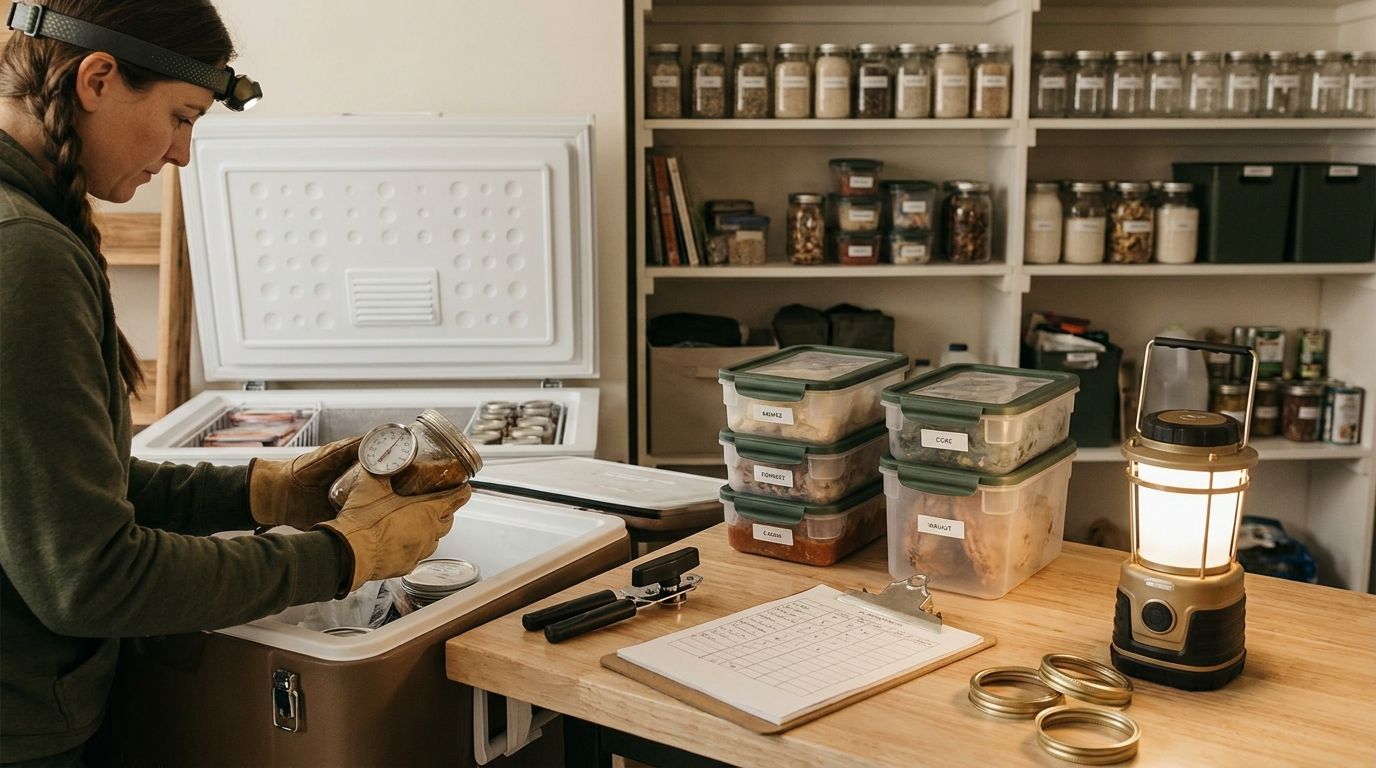
Rosa Wills stands in the kitchen with the fridge door cracked two inches. She's reading the thermometer like it owes her an explanation. Sam points at the freezer shelf where the ice crystals have started to look a little uncertain.
You know that moment. You want to freeze everything and eat everything at the same time. So you do what capable households do: slow down, sort, and rotate. This is a practical framework for power outage food planning that turns a stressful hour into a set of decisions you can repeat every time.
With Mainstay's adaptive learning system, you can keep this method consistent across your household and across outages, so the plan holds up even when your brain is running on fumes.
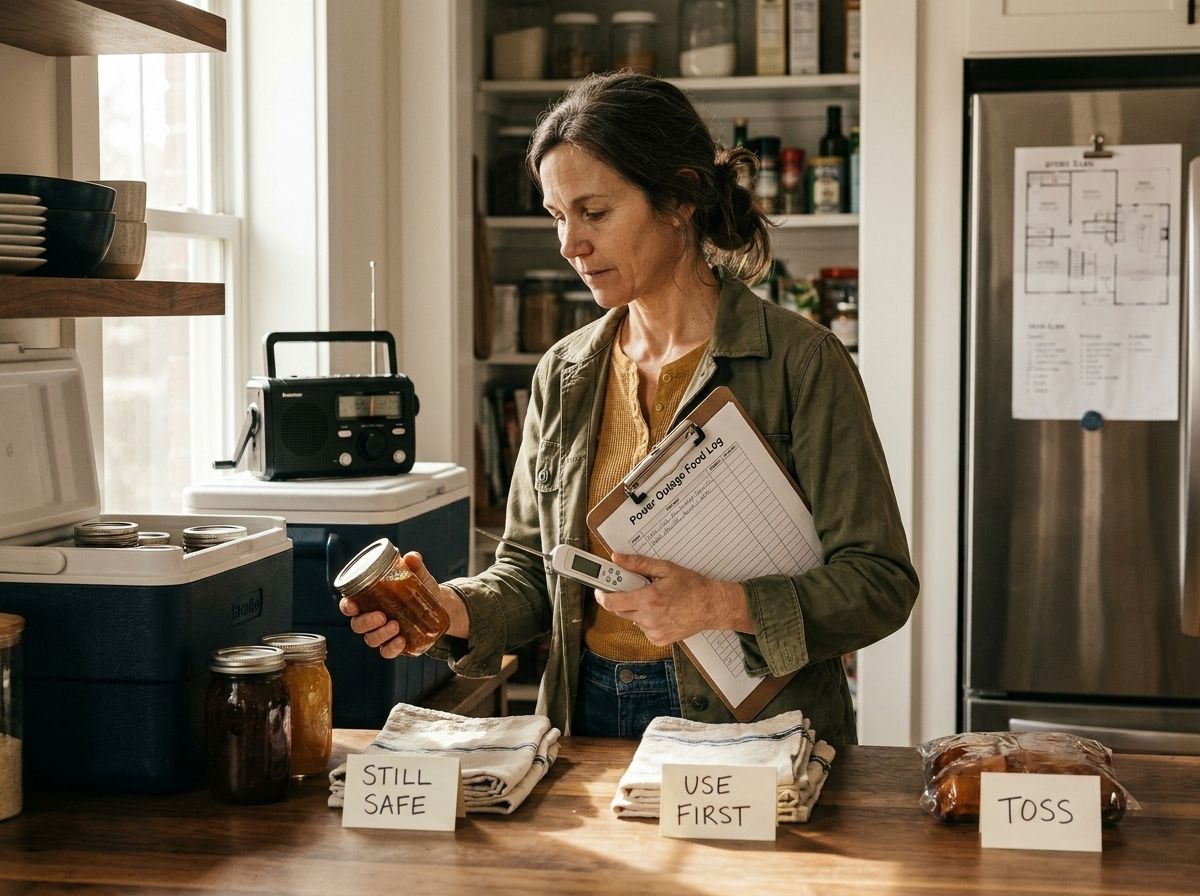
The answer first: still safe / toss / use first
If the power goes out and you need to decide what happens to refrigerator and freezer food, your job is not to guess. Your job is to sort food into three buckets based on time and temperature.
This is the "Still Safe / Toss / Use First" rotation method:
- Still safe: food that stayed cold enough and held its state.
- Toss: food that crossed the danger line for refrigerator or freezer food safety.
- Use first: food that is still okay, but needs to be eaten sooner because it warmed more than the "still safe" bucket.
The CDC food safety guidance is straightforward here: keep refrigerator and freezer doors closed, and discard food that may have been held above safe temperatures. Once you're working with rotation buckets, you stop re-litigating every item one by one.
What actually changes during an outage (and why it matters)
A power outage is not one event. It is a cooling curve.
When power stops, a fridge begins to warm. A freezer warms too, but more slowly, especially when it stays closed and holds a lot of frozen mass. That difference is why freezer food safety is a little more forgiving than refrigerator food safety.
But "more forgiving" is not the same as "safe forever." Temperature is what matters, and time quietly eats your margin.
So you work from the two rules that show up again and again in USDA power outage guidance and CDC food safety guidance:
- Keep doors closed. Every time you open the fridge or freezer, warm air moves in and cold air moves out.
- Use time as your sorting tool. Even if you can't measure temperature precisely, you can track how long the outage lasted and how often you opened the doors.
You might be thinking, "My fridge is warm and my freezer is foggy." That's still usable information. Condensation and ice melt tell you the cold chain is slipping, and that's enough to put items in the right bucket.
Here's a practical way to think about the buckets without turning it into a science project.
Still safe bucket: what you can keep without losing sleep
Put items here when they meet both conditions you can reasonably verify:
- Fridge items: they stayed at a safe temperature for the outage duration, and the door stayed closed.
- Freezer items: they still have ice crystals or are frozen solid, and the freezer stayed closed.
If you have a thermometer in the fridge, use it. If not, work from your best record: how long the power was out and whether you opened the doors. You don't need perfect data to sort. You need consistent assumptions.
Also, "still safe" is not "forever safe." It means safe enough to keep, with a plan to eat or cook it sooner if it warmed more than you hoped. That's where the next bucket comes in.
Toss bucket: what you discard to protect the household
This is the bucket that stings when you paid good money for groceries. I've stood over a crisper drawer feeling personally betrayed by my own shopping list, so I get it.
But toss is not punishment. Toss is risk control.
Use toss when:
- Fridge food likely warmed above safe temperatures long enough that you can't trust it.
- Freezer food thawed enough that it's no longer reliably frozen, especially if it went liquid or the texture broke down.
CDC food safety guidance is consistent on this point: if food has been held too warm, discard it. Food that smells fine can still be unsafe. Your nose is a poor safety instrument.
If you're unsure whether something belongs in still safe or toss, lean toward toss for high-risk items: meat, dairy, eggs, cooked leftovers, and anything ready-to-eat.
Use first bucket: keep it, but eat it soon
Use first is where you get to be efficient.
Place items here when they're likely still okay but carry a higher chance of quality loss or partial thaw. That includes:
- Freezer items with ice crystals that still feel cold, but aren't as solid as they were.
- Fridge items that stayed cold but may have warmed more than you'd like.
Think of use first as your next meal plan. Not "set it and forget it." The bucket that gets you out of decision fatigue and into the kitchen.
A quick rotation rule you can actually follow
When the power comes back, you do this:
1. Check and sort once. Open doors briefly. Decide buckets.
2. Cook and eat from use first first. Make it the priority.
3. Freeze only what you can freeze correctly. If an item thawed significantly, it may not be eligible to refreeze safely.
4. Move still safe into protected storage. Label and note the outage date.
You don't need to run this drill forever. Once per outage, and then your rotation system takes over.
Labeling and rotation: making your next decision easier
The hardest part of power outage food planning is not the outage itself. It's the aftermath.
You've got a stack of containers, a half-melted bag of ice, and a brain that wants to move on. Labeling is how you keep the calm from unraveling.
Set up a labeling system that is boring on purpose.
Three things that make the method stick:
- Use one label style for the outage. Date plus bucket. Example: "7/19 use first."
- Label before you re-pack. If you wait, you forget what you sorted.
- Keep labels visible. Tape on the lid, not tucked under a corner.
How to rotate without guessing
Once you sort into still safe / toss / use first, you rotate the same way you already rotate pantry items.
For use first, plan meals around it within a short window. For still safe, store it normally but keep the outage note so you can track how long it's been since the power event.
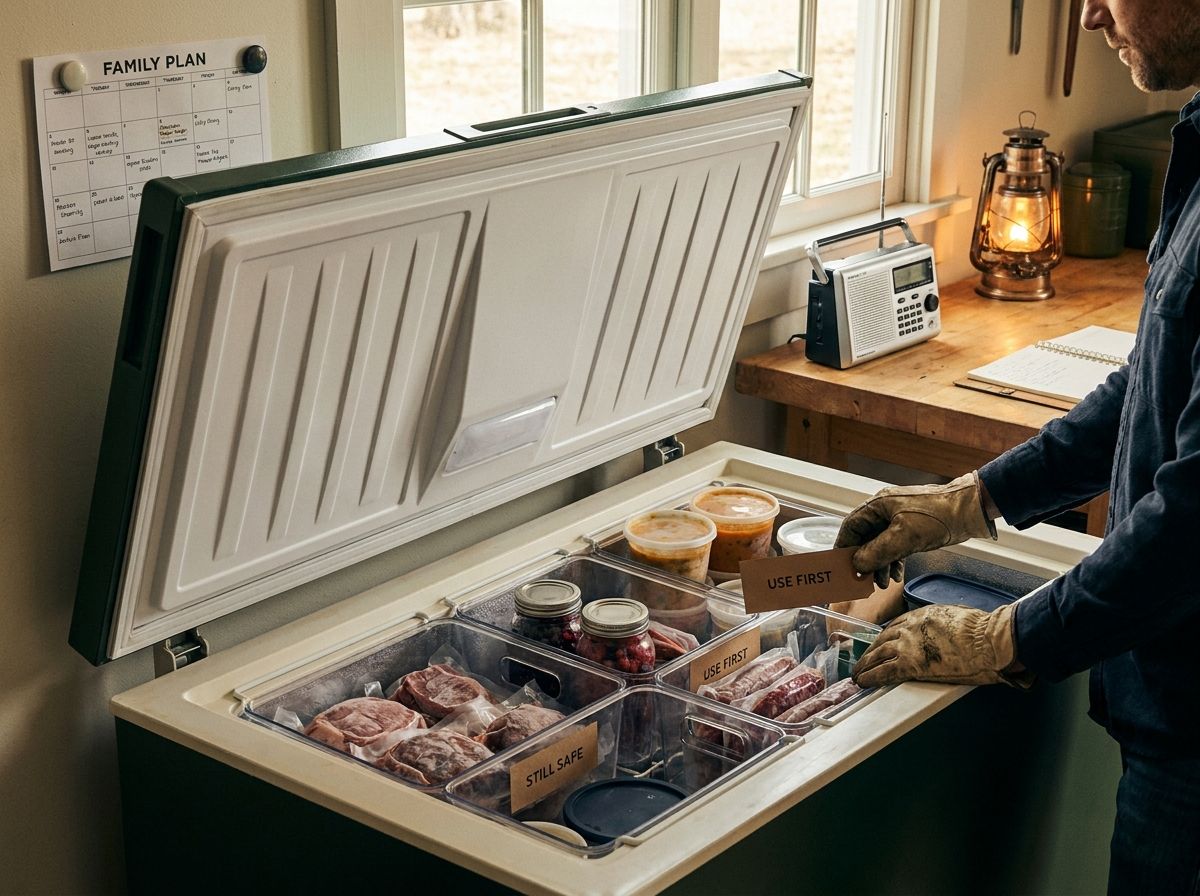
If your freezer holds a lot of small items, consider grouping by bucket:
- One bin for use first
- One bin for still safe
This cuts down on how often you open the freezer, which reduces warming and reduces your own stress.
And yes, you will still open the freezer. You're human. The goal is to open it less, decide faster, and keep doors closed.
A simple "outage log" you can keep on the fridge
Write down three facts. That's it.
- Start time of outage
- Time power returned
- Any door openings (even "opened once for water" counts)
This log turns your sorting from "I think" into "I know." It also helps you apply the same decisions next time, without starting from scratch.
If you live somewhere outages are a regular feature, this log is the difference between a household that learns and one that repeats the same mistakes every time.
Field skills for sorting: how to check quickly without opening everything
You don't need to inspect every jar and bag like you're on a cooking show. You need a fast, consistent scan.
Here's a field-friendly routine that matches how most households actually behave during an outage.
Step 1: confirm your timing and stop opening doors
Before you touch anything, note the start time and estimate how long the power was out. Then resist the urge to "just take a look" every twenty minutes.
Door openings are the silent multiplier. Warm air enters, cold air leaves. That's how refrigerator food goes from "maybe fine" to "toss."
Step 2: scan the fridge for high-risk items first
Start with what's most likely to cause problems if it warmed.
A fast scan looks like this:
- Meat and leftovers
- Dairy and eggs
- Cut fruit and prepared foods
If those items are in the toss zone, you'll likely discard more than you want. But you'll protect your household.
Step 3: scan the freezer based on state, not vibes
For freezer food safety, check whether items are still frozen solid or have thawed enough to be unreliable.
A freezer that stayed closed can hold temperature for a solid stretch. One that was opened repeatedly cannot.
If you see partial thaw, ice melt, or items that feel soft, treat them as use first or toss depending on how long the outage lasted and how much the freezer warmed.
If you're using an "ice crystals" test, run it the same way every time. Consistency is the point.
Step 4: sort containers, not just items
This is where you save time.
Sort the casserole dish as a unit. Sort the bag of mixed vegetables as a unit. Sort the container of deli meat as a container. Then label it with its bucket.
Step 5: make your first meal plan from use first
Use first is not a pile. It's meals.
Pick two or three recipes that cook quickly and use up the items that need attention soonest. If you have a grill or camp stove, factor that in too.
This is one of those moments where competence feels weirdly satisfying. You're not panicking. You're feeding your household.
Where CDC food safety and USDA power outage guidance agree with your instincts
Your instincts during an outage are usually emotional. You want to save food. You want to minimize waste. You want to hold things steady until the power returns.
But CDC food safety guidance and USDA power outage guidance both point the same direction: cold storage rules are temperature rules.
That means your decision framework should prioritize:
- Temperature and time over smell and appearance
- Door discipline over curiosity
- Discarding uncertain high-risk food over "maybe" decisions you'll second-guess later
If you use still safe / toss / use first, you're sorting by the things that actually matter.
And you're protecting your household from the worst outcome: getting sick and then having to retrace every step to figure out what went wrong.
A realistic example from a real kitchen
After one outage, Rosa Wills sorted a freezer bag that had partially thawed. It looked mostly intact. Ice was still visible. Her instinct was to keep it without question.
Then she checked the outage log and remembered the freezer had been opened twice for drinks. She moved it into use first and cooked it the next day.
That's the value of rotation. You don't need to be perfect. You need to be consistent.
Another example: when you toss, you still win
Sam Wills once tossed a container of cooked rice after a longer outage. He didn't love doing it, but he did it anyway.
The next day, the household ate a fresh meal and moved on. The win wasn't the saved food. The win was knowing the household stayed safe.
Competence is often boring. Sort, label, move forward.
FAQ
How long can food stay in a refrigerator during a power outage?
It depends on how warm the refrigerator gets and whether the door stays closed. CDC food safety guidance emphasizes keeping the door closed and discarding food that may have been held above safe temperatures. If you can't trust the temperature, toss high-risk items like meat, dairy, and eggs.
How do I decide if freezer food is still safe?
Use the freezer's state and your timing. If items are still frozen solid, they're more likely to be safe. If items thawed significantly, especially if they went soft or liquid, treat them as use first or toss based on how long the outage lasted and how often the freezer was opened.
Do I need to throw everything out if the outage lasted overnight?
Not automatically, but you do need to sort. Door openings and how much the refrigerator and freezer warmed change the decision. High-risk foods that may have warmed above safe temperatures should be discarded according to CDC food safety guidance.
What should I label after an outage?
Label anything you keep with the bucket and the date of the outage. Use "use first" for items you plan to cook soon, and "still safe" for items you store normally but want to track. This keeps your fridge and freezer decisions from turning into guesswork a week later.
Closing: your household deserves calm decisions
When the power goes out, feeling overwhelmed doesn't mean you're failing. It means you're dealing with information you can't fully measure in the moment.
The still safe / toss / use first rotation method gives you a repeatable path. One that respects what actually matters in refrigerator and freezer food safety: time, temperature, and door discipline.
Start with one practical step: tape an outage log to the fridge and pick one label style for your buckets. The next time the kitchen goes quiet, you'll have a system that lets you sort fast, protect your people, and move on without drama.
Want this handled automatically? See the Mainstay membership.
Subscribe to comment
Join the Mainstay newsletter to leave a comment — and get new field notes in your inbox.
Get new field notes in your inbox
Practical, calm preparedness — one useful note at a time.