The calm power baseline: what you actually need for lighting, charging, and heat
You do not need a bunker. You need emergency power basics that cover light, charging, and heat safety so the rest of life can keep moving.
Rosa Wills keeps a small tote under the kitchen sink. Nothing special about it. A flashlight, a couple of charging cables, and a note card with two phone numbers written in marker.
One afternoon the power flickers, then drops. Rosa does not hunt for batteries. She opens the tote, checks the note card, and the kitchen stays usable.
Sam stands in the doorway with his keys in his hand, doing that thing where his brain tries to run ahead of the problem. June is already at the counter, plugging in the small power bank she knows is charged. Scout circles the kitchen like he's supervising the whole operation. Calm shows up because the baseline is already in place, not because anyone got lucky.
That's what the calm power baseline is. It's the minimum set of working pieces that keep you from improvising when the lights go out. And it's also what makes you feel competent afterward, not just relieved.
This post is built around the backup power essentials you can actually use. Not the fantasy version where everything runs on a generator you never bought. Your baseline should cover three categories you'll feel the absence of immediately: lighting, charging, and heat safety.
With Mainstay's adaptive learning system, you turn that baseline into a repeatable routine, not a one-time project you forget until the next outage.
Why "baseline" is the right frame
Most households either over-plan or under-plan. The over-planners buy a 10,000-watt generator after a bad storm and park it in the garage, where it sits untested for four years (this is extremely common, by the way). The under-planners assume the phone will always have charge and the candles are somewhere in a drawer.
The baseline frame cuts through both. You're not building a bunker. You're building the version of your home that keeps functioning when the grid doesn't, for the first 24 to 72 hours, which covers the vast majority of outages most households ever face.
Three categories. That's it.
Lighting: the part people get wrong first
The instinct is candles. Candles are fine for ambiance on a Tuesday night. For navigating a dark house with kids or pets, they're a liability waiting to happen.
What actually works is a layered approach.
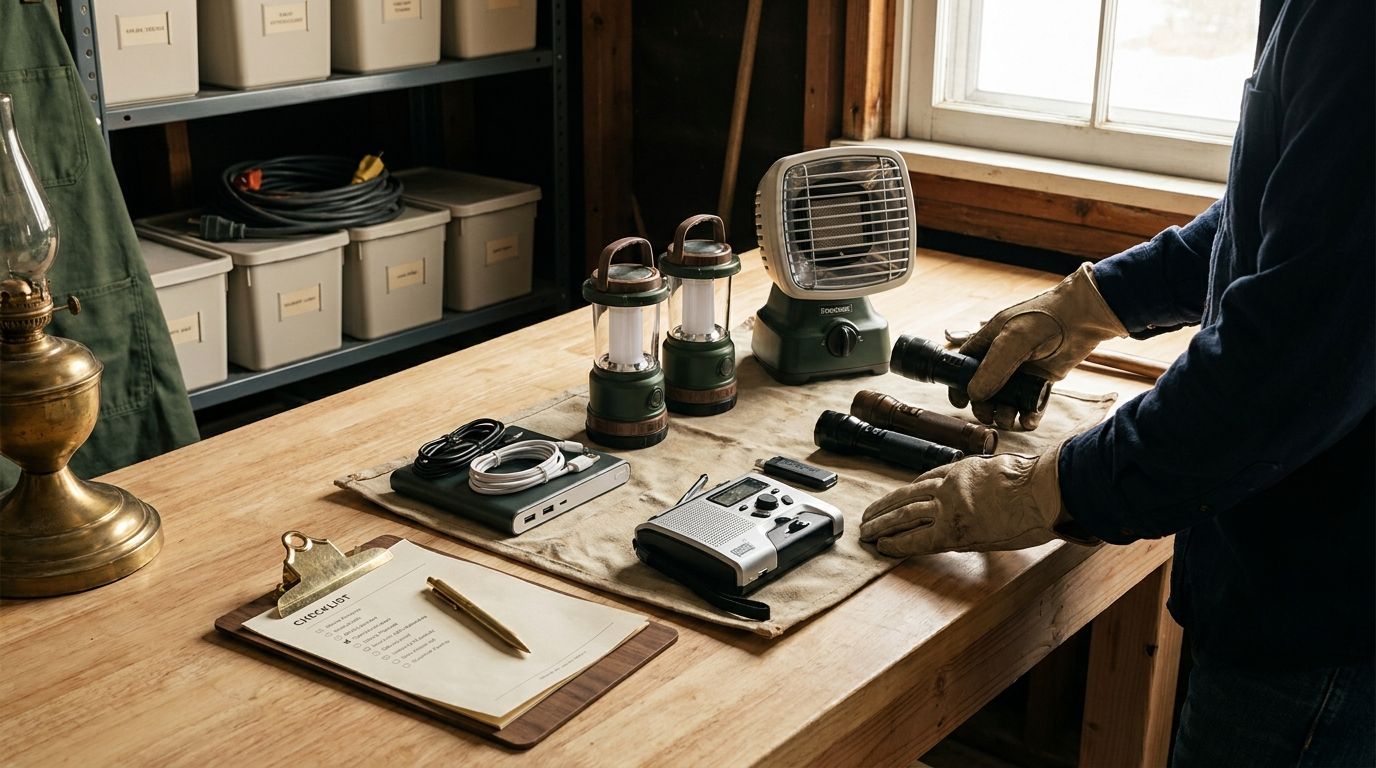
Handheld flashlights are the foundation. You want at least one per floor, stored where every person in the household knows to find it without thinking. Not in the junk drawer. Not "somewhere in the garage." A fixed spot, always. Headlamps are the upgrade most people skip and then immediately wish they hadn't. Hands-free light is a different category of useful when you're resetting a breaker, checking a water heater, or helping a kid find their shoes in the dark. Ambient battery lanterns handle the kitchen-stays-usable problem Rosa solved. A single LED lantern on the counter throws enough light to cook a simple meal, keep the kids calm, and avoid the specific misery of everyone huddled around one flashlight beam.The maintenance piece matters as much as the gear. Batteries degrade. Rechargeables lose capacity. Build a check into your regular household rotation, every three to four months, same time you rotate other supplies. Mainstay's system tracks this so it surfaces as a task, not a vague intention.
Charging: your phone is your communication infrastructure
When the power goes out, your phone becomes the most important device in the house. Weather updates, family coordination, local alerts. It needs to stay alive.
A portable power bank is non-negotiable. The right size for most households is in the 20,000 to 26,800 mAh range, large enough to fully charge two or three phones multiple times. Keep it charged to at least 80 percent as a standing rule, the same way you keep the gas tank above a quarter.
One thing people consistently underestimate is charge decay. A power bank sitting unused for six months may be at 40 percent when you reach for it. Check it on the same schedule as your batteries.
Solar charging panels are a smart addition for outages that stretch past 24 hours. They're not fast, but they're consistent, and they work without any infrastructure at all. A foldable 25 to 60 watt panel pairs well with a power bank and keeps you topped off across a longer stretch.If your household includes anyone who relies on a powered medical device, that changes your calculus significantly. A portable power station in the 500 to 1,000 watt-hour range can run CPAP machines, small medical equipment, and a phone simultaneously. Worth the investment and worth knowing the runtime numbers cold before you need them.
Heat safety: the category people treat as optional until it isn't
Lighting and charging feel urgent. Heat feels abstract until the house drops to 50 degrees at 2 AM.
The goal here isn't heating your whole home. The goal is maintaining one safe, warm space for your household to occupy.
Layered clothing and sleeping bags rated for indoor cold are your first line. A zero-degree sleeping bag in a small interior room can keep an adult comfortable even when the rest of the house is genuinely cold. This is low-tech, reliable, and requires zero power. Propane or kerosene heaters extend your range, but they require strict protocol. Every indoor-rated portable heater needs ventilation, a working carbon monoxide detector nearby, and a household that knows the rules before the situation arises. Not during. Before.What you're building toward is a single designated warm room: interior, small, insulated, with supplies already staged. A bedroom works well. So does a bathroom with a closed door. The smaller the space, the easier it is to hold heat with minimal equipment.
Know your home's weak points before winter. Which rooms lose heat fastest? Where does the cold come in? A quick walk-through on a cold day tells you more than any checklist.
Putting the three categories together
The Rosa Wills tote works because it's complete enough to be useful and simple enough to actually maintain. That's the standard to hold your own baseline to.
Here's what a functional starting point looks like across all three categories:
- Lighting: One flashlight per floor, one headlamp per adult, one LED lantern for a common area
- Charging: One 20,000+ mAh power bank per household, kept charged, plus a solar panel if outages in your area tend to run long
- Heat: Sleeping bags rated for cold, a plan for a single warm room, an indoor-rated portable heater if your climate warrants it, and a CO detector that works
That's a short list. It fits in a tote, a shelf, or a designated cabinet. The point isn't volume. The point is that every item has a place, every person in the household knows where that place is, and nothing on the list is waiting on a battery you forgot to buy.
Mainstay's adaptive learning system ties this together by tracking your specific gear, flagging items before they expire or degrade, and surfacing maintenance tasks on a schedule that fits how your household actually operates. The baseline stays current without requiring you to remember everything yourself.
The maintenance loop is the actual skill
Buying the gear is the easy part. Keeping it ready is the habit that separates a working baseline from a pile of stuff in a closet.
Set a recurring check, quarterly works well for most households. Run through each category. Test the flashlights. Check the power bank charge level. Confirm the propane canister isn't empty. Replace anything that's degraded.
It takes maybe 20 minutes. It's the same kind of methodical check you'd run on any tool you rely on. And when the power drops at 6 PM on a Wednesday, you open the tote, you don't hunt for batteries, and the kitchen stays usable.
That's the whole thing. Calm isn't a personality trait. It's a baseline that's been maintained.
FAQ
What is a calm power baseline?
A calm power baseline is the minimum set of working pieces that keeps a home functioning when the grid goes out. It focuses on lighting, charging, and heat safety rather than relying on a large generator or building a bunker.
What lighting equipment should be included in a power outage baseline?
The article recommends at least one handheld flashlight per floor, stored in a fixed location everyone knows. Headlamps provide hands-free light, while ambient battery lanterns can keep a kitchen or other room usable. Batteries and rechargeable equipment should be checked every three to four months.
How should a household prepare for charging during an outage?
Keep a portable power bank charged to at least 80 percent, with a 20,000 to 26,800 mAh capacity described as suitable for most households. For outages lasting beyond 24 hours, a foldable 25 to 60 watt solar panel can help maintain the charge. Households with powered medical devices may need a 500 to 1,000 watt-hour portable power station and should know its runtime beforehand.
How can a household stay warm without power?
Use layered clothing and sleeping bags rated for indoor cold as the first line of defense. Designate one small, interior, insulated room as a warm space, and stage supplies there. Portable propane or kerosene heaters require ventilation, a working carbon monoxide detector, and clear household rules established in advance.
Want this handled automatically? See the Mainstay membership.
Subscribe to comment
Join the Mainstay newsletter to leave a comment — and get new field notes in your inbox.
Get new field notes in your inbox
Practical, calm preparedness — one useful note at a time.