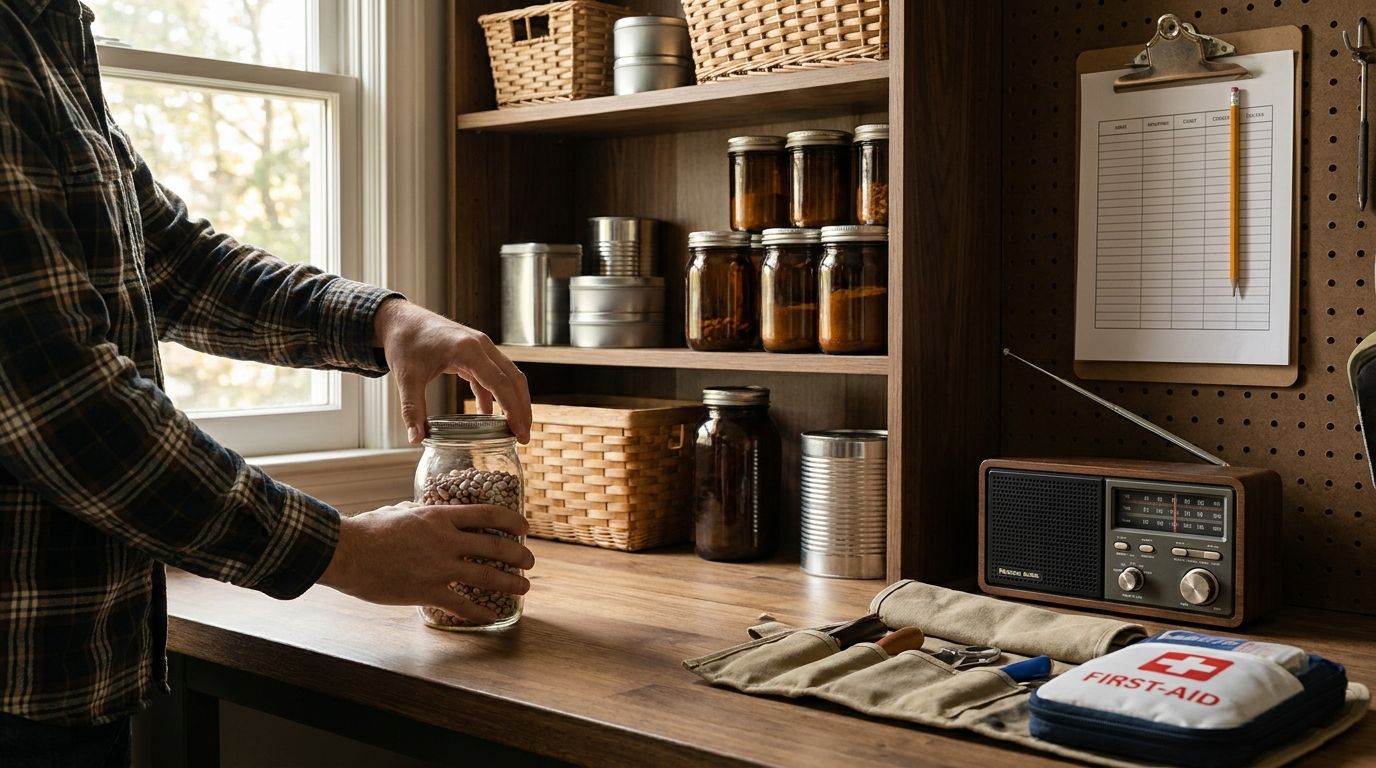
The Everyday Readiness System: Inventory → Rotate → Document (Without Overthinking)
Turn readiness into a household habit. Build a simple inventory, rotate supplies on schedule, and document what matters.
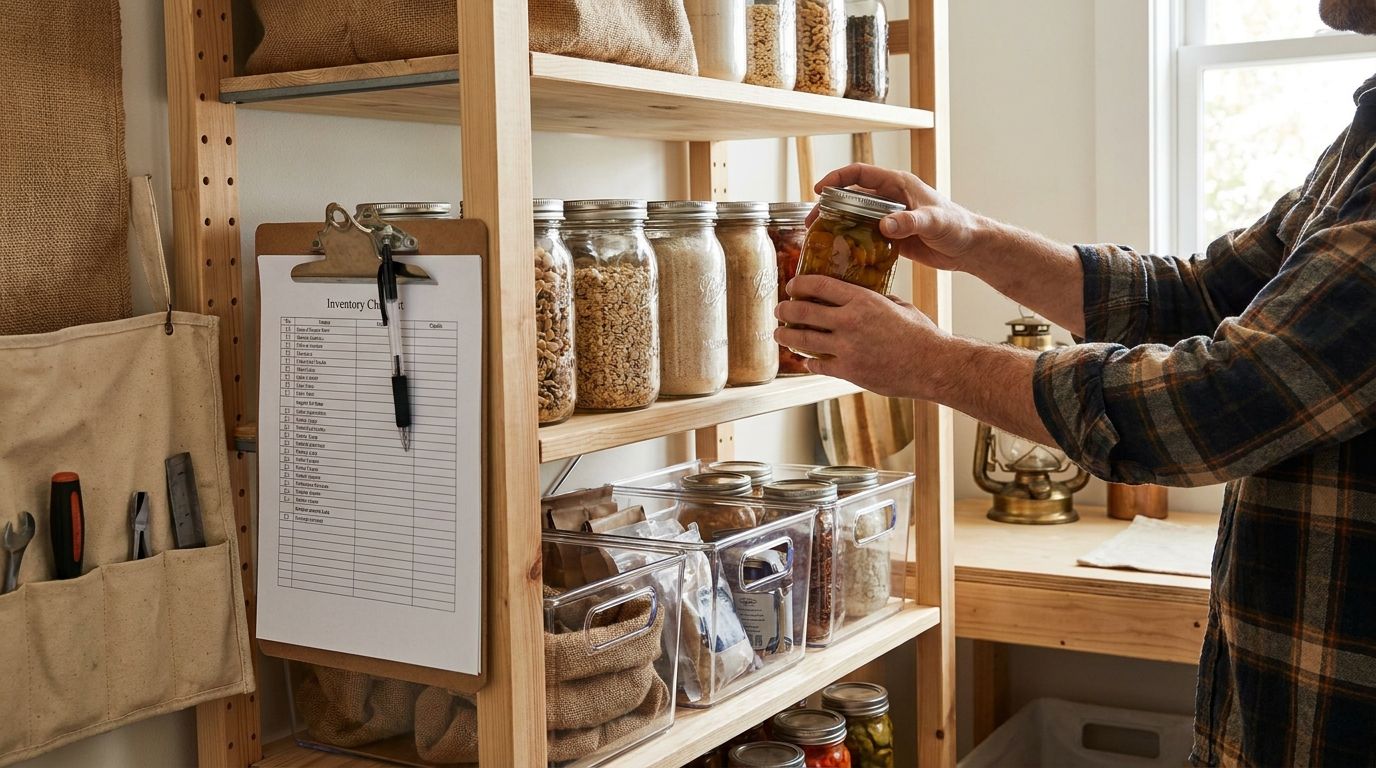
June Wills opens the pantry on a Tuesday night and pauses with a half-smile. The shelf looks fine, but the labels don't match what's actually inside. That moment is the whole point: you don't need more supplies, you need a household inventory system that stays accurate.
This post gives you an Everyday Readiness System built on three moves: inventory, rotate supplies, and document expiration tracking. It's a preparedness routine you can run without drama, without spreadsheets you hate, and without waiting for "someday" to catch up with you.
The thesis: inventory first, rotate second, document always
The everyday readiness system is not a big project. It's a small loop you run often enough that your future self never has to guess.
When people skip the loop, they usually do one of two things: they buy duplicates because they can't find what they already own, or they discover expired items during a stressful moment when the motivation to reorganize is at its lowest.
Your loop prevents both. Here is how it works in plain terms.
- Inventory is what you have. You list it by category, not by perfection.
- Rotate supplies is how you keep it usable. Old stock moves forward, new stock goes to the back.
- Document is how you remember. You track what expires first and when you last checked.
Do those three moves consistently and preparedness becomes maintenance. Like keeping tools in working order. No heroics required, just a method.
And yes, you will still run into oddities. A jar gets pushed behind another jar. A box gets opened and partially refilled. Life happens. The system is designed to absorb that mess and still end with a clear answer: what you have, what you need, and what expires next.
You'll also notice something calming. When your household inventory system is current, decision-making gets easier. You stop debating. You just restock based on what the label says and what your rotate supplies schedule supports.

Step 1: Inventory without building a second job
Inventory is where most people overthink. They try to catalog every item down to the last unit. That is not the goal.
The goal is a preparedness checklist you can use while standing in the room. One category at a time. One shelf at a time.
Start with categories that match how you actually use things. For example:
- Water and hydration (filters, bottles, purification drops)
- Food storage (ready-to-eat meals, staples, pet food if you have it)
- Household essentials (toiletries, cleaning concentrates, trash bags)
- Medical supplies (bandages, antiseptic, prescription backups if applicable)
- Power and light (batteries, headlamps, chargers)
Then pick a "home base" location for each category. The system works better when every category has a predictable landing spot. If your batteries live in three different places, you will never feel fully confident.
A practical approach that stays manageable:
1) Choose one inventory zone per week.
2) Write what you see, not what you remember.
3) Record counts and expiration dates only when they exist.
You do not need to invent expiration tracking where there is none. If an item has no date, note "no date" and move on. You are building a system, not grading yourself.
Concrete scenario: the under-sink surprise
Rosa Wills does a quick check under the kitchen sink and finds two half-used bottles of drain cleaner and one unopened bottle with a label that says "Do not freeze." Not exactly a grab-and-go item, but still a household readiness item because it affects day-to-day function.
So you record it under household essentials with a simple note: "Do not freeze." Now it is part of your preparedness routine, and you stop storing it where temperatures swing.
Concrete scenario: the garage battery pile
Sam Wills finds mixed battery types in a drawer. He also finds a headlamp that works but has a dead battery inside. You fix both with one inventory move: batteries get their own labeled container, and the headlamp gets a fresh battery now, not "later."
The inventory output should answer questions fast:
- Do we have enough for a month of normal use?
- What expires first?
- What is missing compared to our baseline?
If your notes do that, you are winning.
Step 2: Rotate supplies like you restock groceries
Rotation is the part of preparedness that feels like common sense once you set it up.
Most homes already rotate food. You move older cans forward and put newer ones behind. The same idea works for emergency supplies, with a twist: you track expiration dates so you do not rely on memory.
A simple rotate supplies method that never breaks
Use "front is oldest" staging.
- When you add new items, put them behind the existing ones.
- When you remove items for use, take from the front.
- When you notice an item is nearing its date, treat it like a normal restock item, not a crisis.
This works best when each category has a clear container or bin. If "food" is spread across five boxes, rotation becomes a scavenger hunt.
You can also create a "use first" shelf or bin. Not fancy. Just a physical reminder.
Concrete scenario: the first-aid kit that actually gets used
Theo Wills pulls the first-aid kit from its cabinet after a kitchen cut. He finds a tube of ointment that is past its date. You could call it a failure. Or you can treat it as data.
Now the kit has a front section and a back section. When you restock, you put new ointment behind the old one. When you audit, you check the front section first.
This is where your expiration tracking becomes real. You are not tracking dates for the sake of tracking. You are tracking so you can rotate supplies before they become a problem.
What research says about rotation (and why it matters)
Expired medications and supplies are a known issue in household preparedness. The exact failure rate varies by product and storage conditions, but public health guidance consistently emphasizes that shelf life is not a suggestion. In the US, the FDA requires drugs to be labeled with expiration dates, and stability can change after opening or improper storage. For shelf-stable foods, storage time depends on packaging and conditions, which is why expiration tracking is useful even when items "look fine."
You do not need to memorize stability charts. You need a rotate supplies routine that makes dates visible.
Step 3: Document expiration tracking in a way you will use
Documentation fails when it becomes a separate project.
Your system should make documentation the last step of inventory, not a new chore. Pick one place to store your records. It can be a notebook, a phone note, or a sheet in a binder. The format matters less than the habit.
What to record for each item
For each category, write:
- Item name
- Count or quantity
- Expiration date (if it has one)
- Location (where it lives)
- "Last checked" date
That is it.
If your household inventory system is built around containers, location becomes simple. "Kitchen pantry shelf A" beats "somewhere near the rice."
Use a "next action" note
The best documentation includes one line that tells you what to do next.
Example:
- "Ointment expires 10/2026. Use first during next family care run."
- "Batteries: AA expires 06/2027. Rotate into headlamp bin."
You are building a preparedness checklist that points forward.
Concrete scenario: labeling that matches the real shelf
In one kitchen, June Wills labels a bin "Water purification." The label is correct. Then she moves the purification tablets into a different container because the original bin was full.
If you do not document, you lose the label's meaning. So she adds one update in her notebook: "Tablets moved to fridge door bin." Now the label and the record match.
That is the whole trick. Documentation is not about being right forever. It's about staying right enough.
Where Mainstay fits your routine
With Mainstay's adaptive learning system, you build a household inventory system that stays readable and actionable. It nudges you to rotate supplies and update expiration tracking without turning it into a spreadsheet lifestyle. (You still do the work. The system just keeps the loop from slipping.)
Step 4: Set a preparedness routine cadence you can keep
Consistency beats intensity. That is the quiet rule.
You do not need a daily check. You need a cadence that matches how fast your supplies change. Here is a practical schedule that stays realistic:
- Weekly: inventory zone review for one area (pantry, bathroom, garage)
- Monthly: rotate supplies check for anything with dates in that month
- Quarterly: verify category baselines (do you still have enough for your chosen baseline?)
- After use: update documentation immediately for opened dated items
You can compress or expand this. The key is to avoid the "big audit once a year" trap. That approach feels thorough until you realize you've been guessing for 11 months.
How to choose your baseline
Your baseline is not a number someone else decided. It is your household's reality.
Ask:
- What do you use every month under normal life?
- What do you want to cover if you cannot shop for a short stretch?
- What items expire quickly enough that you must rotate supplies anyway?
Then set baseline counts so your rotate supplies schedule stays easy.
If you pick "two months of basics," your inventory becomes a living thing. You use it, you restock it, and it stays current.
Concrete scenario: the "winter bathroom" problem
During winter, Rosa Wills notices the bathroom cabinet gets used hard. Hand soap, wipes, and some cleaning concentrates disappear faster than expected. The inventory zone review catches it because you check that cabinet weekly.
So you adjust the baseline for that category. Now your preparedness routine matches seasonal reality.
This is why your system should be built around inventory zones, not a perfect master list of everything you own.
Step 5: Build a preparedness checklist that reduces decision fatigue
The best preparedness checklist is not long. It is direct.
When you stand in front of a shelf, you need to know what to do in under five minutes. A checklist should include:
- What to check first (the front of bins)
- What to update (count, expiration tracking, location)
- What to restock (based on your baseline)
- What to move (rotate supplies forward)
A "no overthinking" checklist you can print
Use this template for each inventory zone:
- Open the bin and check the front row first.
- Write current counts.
- Record any expiration dates that are within the next 90-180 days.
- Note any missing items.
- Move older items forward, new items back.
- Update the location note if anything moved.
If you do that, you are not just collecting data. You are running a preparedness routine.
Keep your inventory system clean
Your system stays usable when it stays tidy.
- Use bins with lids for anything dated.
- Keep a "refill stack" of packaging you can grab during restock.
- Store like with like so rotation is obvious.
And one small habit that saves real time: keep a pen or label maker at the spot where you do inventory. If you have to hunt for tools, the system slows down and eventually stops.
What about digital tracking?
Digital works if it is fast. If you need to open five apps, it is too slow.
A phone note with categories and dates can work. A paper notebook can work better if you already keep one in the house. The "best" household inventory system is the one you actually update.
Step 6: Troubleshoot the three common ways the loop breaks
Even a good system breaks sometimes. That is normal. The goal is to notice the failure pattern and fix it.
Problem 1: You inventory, but you do not rotate
This happens when you treat inventory as a one-time task.
Fix it by making rotation the default action during restock. When you buy dated items, put them behind the oldest ones. When you use items, take from the front. If you do nothing else, do that.
Problem 2: You rotate, but your expiration tracking is outdated
This happens when you update the shelf but not the record.
Fix it by documenting immediately after any change. When you open a container, update the record the same day. When you move an item to a new location, update the location line.
A record that is a week old is usually good enough. A record that is a year old is a guess.
Problem 3: You document, but you cannot find what you recorded
This happens when the record and the storage layout drift.
Fix it with naming consistency. Use the same bin names every time. Keep categories in the same inventory zones. If you change your layout, update the record first, then move the items.
A quick "reset" move when you feel behind
If your system has slipped, do not start over from scratch.
Pick one category. Inventory it. Rotate supplies within that category. Document expiration tracking for that category. Then stop. That small win gets your momentum back.

Putting it all together: the Everyday Readiness System in one pass
Here is what the loop looks like when you run it end to end.
The pass
Choose one inventory zone, like the kitchen pantry or bathroom cabinet.
1) Inventory: write down what you have.
2) Rotate supplies: move older items to the front.
3) Document expiration tracking: update counts, dates, and location.
4) Plan the next buy: restock only what your baseline calls for.
You now have a preparedness checklist that tells you exactly what to do next time.
Example: pantry loop with real labels
On a Saturday morning, June Wills opens the pantry. She checks the front row of bins. She notes dates on the items with labels. She moves older items forward and newer items behind.
Then she updates her notebook with one line: "Refill granola bars by end of August, 2 boxes remaining." Now the pantry is ready for the next month, not the next fantasy.
Example: bathroom loop with seasonal reality
Rosa Wills checks the bathroom cabinet. She counts what is there. She notices hand soap refills are lower than last time, rotates anything dated, and updates the record.
Now the next restock is not a surprise. It is scheduled based on what the household inventory system says.
Example: first-aid loop after a real use
Theo Wills uses a bandage and ointment. Later that day, Sam Wills updates the record with the new count. He checks the front of the bin for anything nearing its date.
That is the loop working. Inventory happens right when it matters, rotate supplies happens as part of restock, and document expiration tracking happens immediately.
With Mainstay's adaptive learning system, you keep this loop from becoming a forgotten intention. You get a structure that makes the next step obvious, so the system stays calm and usable.
FAQ
What is a household inventory system, exactly?
A household inventory system is a simple record of what you own by category, where it lives, and what expires first. It is not a full catalog of every item. It is a preparedness checklist you can use while standing in front of the shelf.
How often should I rotate supplies?
Rotate supplies whenever you restock and at least monthly for items with expiration dates. If you run a weekly inventory zone review, rotation naturally stays current because you keep using the front row first.
Do I need to track expiration dates for everything?
No. Track expiration dates for items that have them and matter to your baseline, like medications, food storage items, and dated hygiene supplies. For items with no date, note "no date" and focus on counts and location.
What if my supplies are spread out across different rooms?
Consolidate by category into predictable inventory zones. If you cannot consolidate fully, create separate records for each location. The worst system is the one where you wrote it down but cannot find it.
How do I avoid overthinking inventory?
Use one zone per check and write what you see. Record counts and expiration tracking when dates exist, then stop. Your system should be fast enough that you will actually do it again.
Next step: do one inventory zone today
Pick one place you already touch every week, like your kitchen pantry or bathroom cabinet. Inventory what you see. Rotate supplies so older items face forward. Update your expiration tracking notes and write one line for your next restock.
When you finish, you should be able to answer one question without guessing: what expires next in that zone. That is the win. Then you repeat the loop in the next inventory zone when your next weekly check lands.
Want this handled automatically? See the Mainstay membership.
Subscribe to comment
Join the Mainstay newsletter to leave a comment — and get new field notes in your inbox.
Get new field notes in your inbox
Practical, calm preparedness — one useful note at a time.