The household water safety map: boil, filter, and disinfect what to do first
When a boil water advisory hits, you need a clear order of operations. Here’s a simple household water safety map to decide boil, filter, or disinfect first.
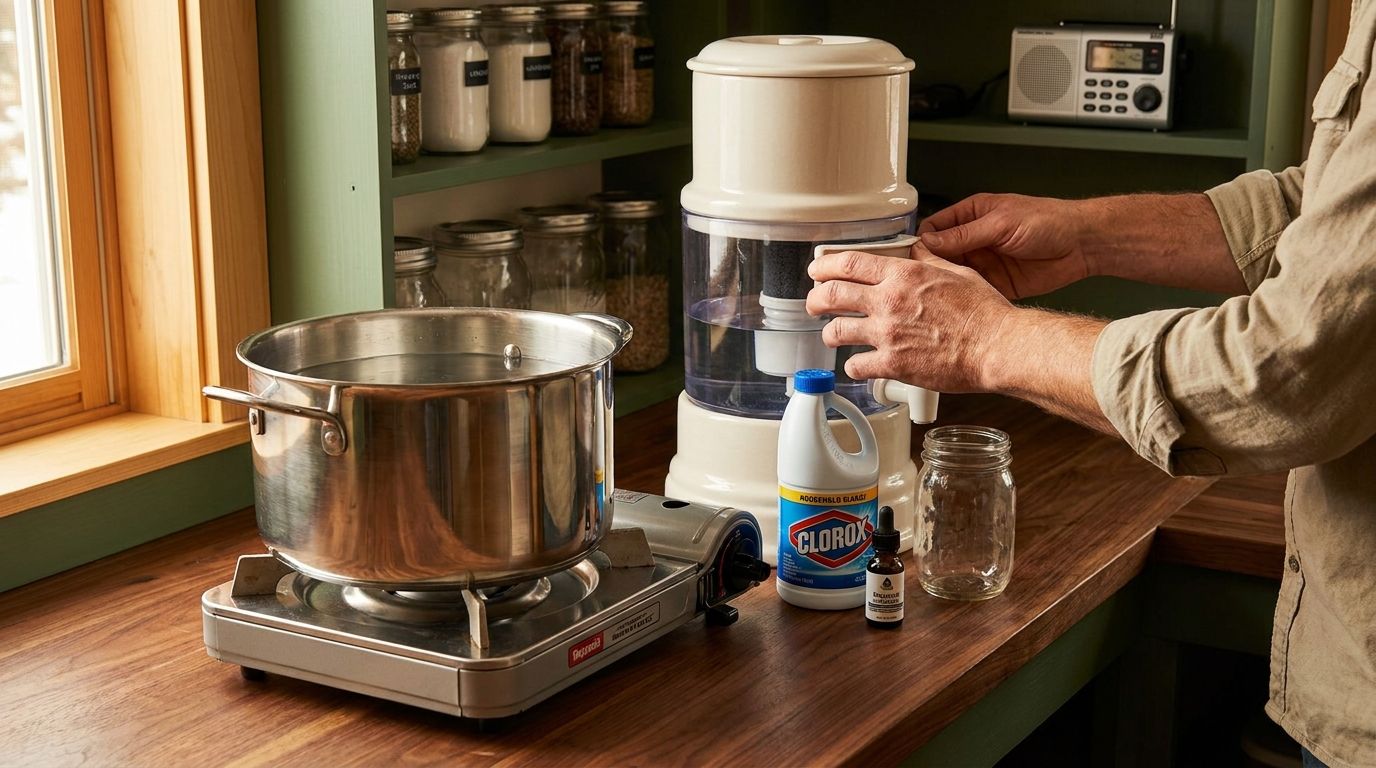
Rosa Wills stands at the kitchen sink with a half-full pitcher and a sticky note she just printed from her phone. Sam reads the alert again, then looks at the kids' cups like they're going to solve the problem by being cute. June says, quietly, "Okay. We do the steps in the right order."
That is the whole point of a household water safety map. You are not guessing. You are matching the type of risk to the type of treatment, then doing what works first.
Here is the answer for the moment you need it: start by checking whether you're under a boil water advisory. If you are, boil first for drinking and cooking, then use filtration and disinfection for the "what about everything else" parts. If you are not under an advisory and you're dealing with cloudy water or a known contamination source, filter first and disinfect next.
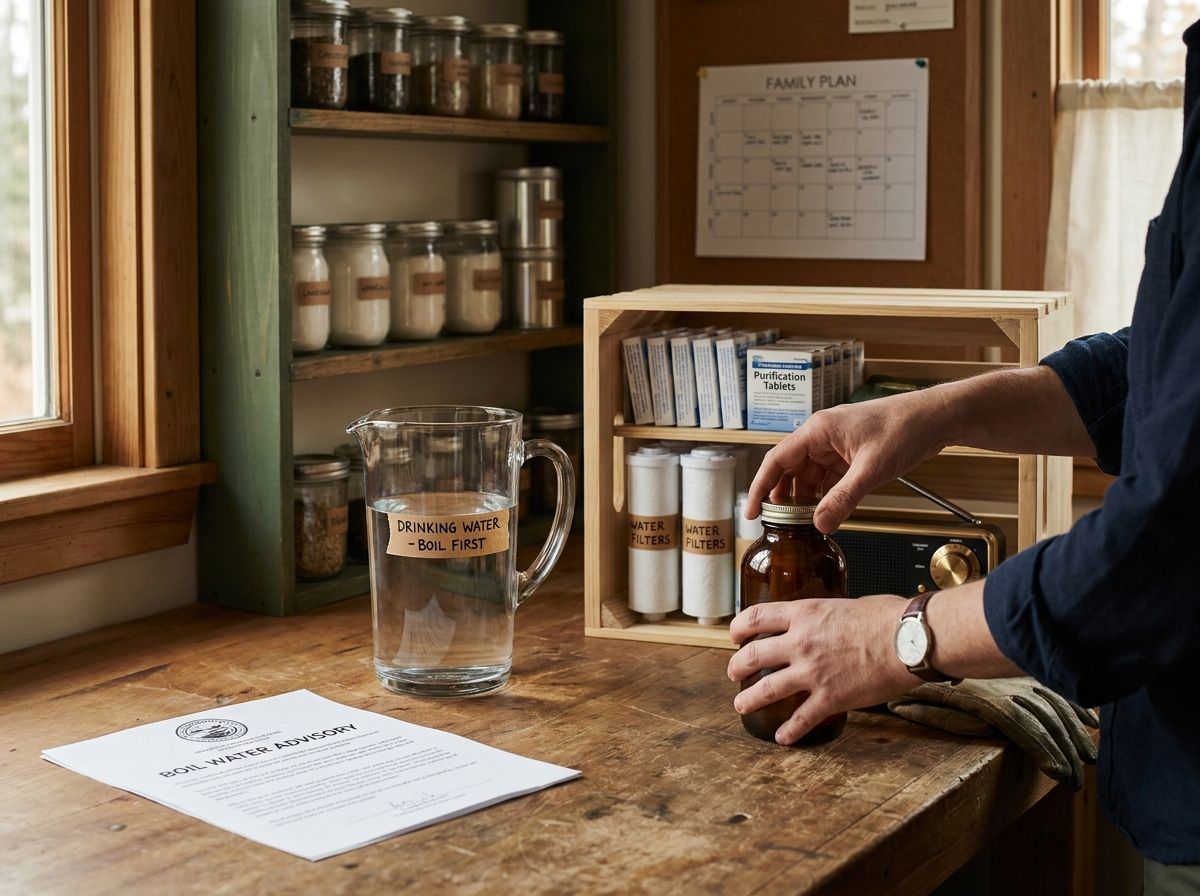
That order matters because different treatments handle different problems, and because your household is already busy. You need calm steps that fit real life, not a textbook.
The household water safety map: your decision order
Your map has three zones. Think of them as labels on a whiteboard, not a test.
1) Zone one: boil water advisory is active
When a boil water advisory is in effect, the safest move for drinking and cooking is boiling. Heat is the tool that reliably knocks down most bacterial and pathogen risks, which makes boiling a complete treatment in a way that other methods simply are not.
What you do first:
- Put drinking water and cooking water on boil immediately.
- Use bottled water if you have it for the fastest "no drama" option.
- Keep a pot for boiling dedicated to water safety so it does not get mixed up with regular kitchen life.
Then you decide what to do about other uses. You can usually use tap water for handwashing, cleaning, and bathing unless the advisory says otherwise. But keep drinking and cooking water separated until you get an all-clear.
CDC guidance consistently emphasizes that boiling during an advisory is meant to make water safe to drink, and it also distinguishes between drinking water safety and general household use. FEMA water safety guidance follows the same practical approach: treat water for consumption first, then expand as needed.
So if you're standing in your kitchen with a pitcher, the map starts with the advisory itself. Not the rumor. Not the "I think it's probably fine." The alert.
2) Zone two: you are not under an advisory, but water is questionable
This is the messy middle. It shows up after a storm, a main break, a power outage that affects pumps, or when you see cloudy water coming out of the tap. In this zone, the goal is to reduce two different threats: particles that make water look dirty and can hide microbes, and microbes that can be present even when water looks "kinda okay."
What you do first in this zone:
- Filter first if the water is cloudy or has sediment.
- Disinfect after filtering if you are treating for drinking.
Why filter first? Many household filters work better when water is not full of grit. Skip that step and you burn through filter capacity fast, and some filters do not perform as well when they are overloaded.
Then you disinfect. Disinfection is the step that targets microbes. Chlorine bleach, chlorine tablets, and similar disinfectants are common household tools; the exact contact time depends on the product and concentration, so you follow the label or a trusted water treatment guide.
One small note that saves headaches: "filter" is not "disinfect." A filter can remove pathogens if it is designed for that purpose, but many common household filters are mainly for taste and sediment. If you are treating for safety, use a filter rated for the hazard you care about, and disinfect when the situation calls for it.
3) Zone three: you are dealing with a known contamination source
This zone is when you know what happened. A flooded well. A chemical spill near the water line. A backflow event. A fire suppression system that got into the supply. The map still follows the same order: treat drinking and cooking water first, then expand.
But you also get stricter. You might need to stop using a source entirely until professionals verify it. For household wells, local health departments and water testing services matter a lot here.
If you cannot get clear instructions quickly, your safe default is this: boil water for drinking and cooking, and use bottled water if boiling is not practical. For other uses, follow your local guidance.
This is where competence beats panic. You are not trying to solve the whole system. You are keeping your household safe with the tools you have.
What to do first when the alert hits: a practical flow you can follow
Let's make it concrete. You get the notification. Or you see the sign on the door. Or your neighbor texts a screenshot.
Your first 15 minutes look like this.
Step 1: confirm the advisory and what it covers
Read the alert for:
- Whether it says "boil water advisory" or "do not drink"
- The affected area or water system
- When it starts
- Whether it includes instructions for specific uses
Then check your household's immediate needs. If you are feeding infants, cooking rice, making formula, or taking medications that require safe water, treat those as priority.
Step 2: set up "safe water" containers right away
This is the part people skip, then regret.
You want one place for treated water and one place for untreated water. Labeled jugs help. Even a marker on tape helps. The goal is to stop accidental mixing.
If you boil, cool the water safely before pouring it into drinking containers. If you disinfect with tablets or bleach, use the correct amount and wait the full contact time.
Step 3: decide which treatment matches the job
Use this simple household water treatment matching:
- Boil for drinking and cooking during a boil water advisory.
- Filter for cloudy water and sediment reduction.
- Disinfect for microbes, especially when water quality is questionable.
You can use more than one step. In the "questionable water" zone, filter then disinfect is a strong approach.
Step 4: handle the rest of the day without turning it into a project
Your household still needs to run. So you plan around it.
You can do these without overthinking:
- Handwashing: follow your local instructions. Many advisories allow tap water for handwashing.
- Bathing: follow the advisory language.
- Brushing teeth: use treated water if you are being cautious.
If the alert is specific, you follow the specific wording. If it is vague, treat drinking and cooking as the non-negotiable.
With Mainstay's adaptive learning system, you can turn this flow into a reusable "if this, then that" routine in your household notes. That way, the next time an alert hits, you do not start from scratch while your brain is tired.
Build your household water treatment kit around the map
You do not need a warehouse. You need the right tools for the order.
Here are the essentials that match the three zones.
Boil water tools
- A dedicated pot or kettle that you can use for boiling water.
- A way to cool boiled water safely and store it in labeled containers.
- A plan for fuel or power if boiling is your primary method.
If you already have a camping kettle, that can pull double duty. Your stove pot works fine too.
Filtration tools
- A filter designed for the kind of contamination you care about, and that you actually know how to use.
- Spare filter elements if your filter uses them.
- A way to pre-filter if water is very cloudy.
If you have ever tried to run a filter on muddy water, you already understand why this matters. The filter clogs, the process slows down, and then you start making decisions under stress. Pre-filtering turbid water before it hits your main filter is not extra work, it is protecting your equipment.
Disinfection tools
- Chlorine tablets or liquid bleach for household disinfection.
- A measuring method, because eyeballing the dose is how you get inconsistent results.
- A timer for contact time.
Bleach-based disinfection works when done correctly, but it depends on concentration and the product. That is why the label matters. CDC guidance and FEMA water safety guidance both stress using proper disinfectant amounts and contact time.
Storage and labeling tools
- Clean containers with lids.
- Labels that say "treated drinking water" and "untreated."
- A marker that works on plastic.
Not glamorous. Also the difference between "we treated water" and "we accidentally drank from the wrong jug."
Common mistakes people make (and how to avoid them calmly)
You are not failing if you feel thrown off by a water alert. The mistake is trying to wing it.
Here are the patterns that show up in households, including the ones that are usually organized.
Mistake 1: treating the wrong water first
If you start with bathing or cleaning and then remember drinking and cooking, you lose time and you create opportunities for mix-ups.
Fix: treat drinking and cooking first. That is the map. Everything else follows local guidance.
Mistake 2: assuming "filter" equals "safe to drink"
Some filters improve taste and reduce sediment. Helpful. Not the same as disinfection.
Fix: know what your filter is rated to do. If you are treating for safety, use CDC guidance and product instructions. In the questionable-water zone, filter then disinfect.
Mistake 3: skipping contact time for disinfection
Disinfectants need time to work. Cut the wait short and you lose the benefit.
Fix: use a timer. Set it and walk away for the duration. Yes, it feels a little tedious. It also works.
Mistake 4: storing treated water without labels
This one hits during busy days. Someone pours from the wrong container. Someone "just tastes it."
Fix: label treated water immediately. Use different containers for treated and untreated water.
Mistake 5: forgetting formula and medications
Formula needs safe water. Medications often require safe water for mixing or ingestion, depending on the prescription.
Fix: if you have infants or medication routines, treat those as priority needs in your household water safety map.
Keep the map updated: when the advisory lifts, you reset
The hardest part is not the start. It is returning to normal.
When the advisory is lifted, stay methodical:
- Use treated water until you confirm the all-clear applies to your area.
- Stop boiling only when the guidance says it is okay.
- Replace or restock what you used.
- Note what worked and what slowed you down.
That note is worth something. It turns a stressful event into a training run.
And if you want a quick way to stay organized, write a small "water safety map" card and keep it near your supplies. It should show your decision order:
- Advisory active: boil for drinking and cooking.
- Questionable water: filter for cloudiness, disinfect for microbes.
- Known contamination: treat drinking first, follow local guidance for the rest.
Not fancy. Usable.
FAQ
What counts as a boil water advisory?
A boil water advisory is a public health notice that says the water may contain germs and that people should boil it before drinking or cooking. The wording matters, so you follow the specific instructions for your area and the time window listed in the alert.
Do I need to disinfect water if I already filtered it?
Often you do, especially when water quality is questionable and you are treating for drinking. A filter can remove particles, but disinfection targets microbes. If you are in the questionable-water zone, filter first for clarity, then disinfect for safety.
How long should I disinfect water?
The time depends on the disinfectant you use and the concentration. Always follow the product label or CDC guidance for contact time. If you use bleach, measure carefully and do not shorten the waiting period.
Can I use tap water for brushing teeth during a boil water advisory?
Many advisories recommend using boiled or treated water for drinking and cooking, and they may include guidance for brushing teeth. When you want a simple rule that reduces risk, use treated water for brushing as well, especially for kids.
The next step: make one decision card and put it where you already keep your supplies
Tonight, grab a notepad or a sheet of paper and write your household water safety map in plain words. Put it near where you keep bottled water, filters, tablets, or your emergency kit.
Rosa Wills did that after the alert. Sam taped it to the inside of the pantry door, right next to the flour. June said, "Now we are not improvising."
That is the calm win. You are not chasing the worst-case scenario. You are following the right order when it matters, and you are doing it together.
Want this handled automatically? See the Mainstay membership.
Subscribe to comment
Join the Mainstay newsletter to leave a comment — and get new field notes in your inbox.
Get new field notes in your inbox
Practical, calm preparedness — one useful note at a time.