Water plan for real life: how much water to store by household size and scenarios
You can calculate emergency water supply in minutes. Use household size and realistic scenarios to set a storage number you can actually maintain.
Rosa Wills fills two jugs at the sink, then stops and stares at the cabinet. She knows the number matters, but guessing is how good intentions turn into half-empty containers. This guide gives you a practical emergency water supply plan you can size by household size and real-life scenarios, using CDC water storage guidance as your baseline.
With Mainstay's adaptive learning system, you can turn that baseline into a clear water planning worksheet: how much water to store, what to rotate, and how to document your plan so it stays true.
The basics, done right (and measurable)
The math is simple. The hard part is choosing the scenario you're planning for, then storing the amount that matches how you actually live.
Most households plan for drinking and basic sanitation. Water planning usually separates into two buckets:
- Drinking and cooking water (you can estimate by servings)
- Sanitation water (you use less than you think, but you still need a reserve)
A common CDC water storage guidance baseline is 3 days of water for each person, with a typical planning amount of about 1 gallon per person per day. That number is not magic. It is a planning tool. Real life varies based on heat, activity, and whether you can reach safe water sources.
Here's the key idea: you are not building a museum display. You are building a working supply that you can use, rotate, and replace without drama.
Before you calculate, decide what your "household" means:
- Adults who drink normally
- Children who may drink more than you expect
- Anyone with medical needs that increase water use (breathing treatments, specific medications)
- Pets, if you want your plan to cover them too
Then decide your scenario. Many households start with a 72-hour emergency water supply plan, then add coverage for longer outages based on their home setup and local conditions.
How much water to store by household size (the core number)
Start with the core number: drinking water for the days you plan to cover.
A solid, practical emergency water supply target for most households looks like this:
- 1 gallon per person per day for drinking
- Multiply by the number of people
- Multiply by the number of days you plan for
If you store more, you're not wrong. But store too little and you end up rationing in a way that feels like punishment.
Quick household sizing table (drinking water)
Use this as your first pass. Then adjust for scenarios in the next section.
- 1 person for 3 days: 3 gallons
- 2 people for 3 days: 6 gallons
- 3 people for 3 days: 9 gallons
- 4 people for 3 days: 12 gallons
- 5 people for 3 days: 15 gallons
If you also plan for cooking, the same 1 gallon per person per day works as a baseline. Add a small buffer if your outage cooking routine is heavier than usual.
Add sanitation water as a practical buffer
Sanitation is where people overestimate and underestimate at the same time. You don't need to fill bathtubs. You do need enough water to handle basic hygiene and waste management without cutting corners.
A common planning approach is to treat sanitation as a percentage on top of your drinking total. One simple rule to start with:
- Start with your drinking total
- Add 25% to 50% more water if your outage plan includes limited toilet flushing, handwashing, and surface cleaning
That range is intentionally wide, because your bathroom setup and your own comfort level both matter here.
Pets: keep it separate in your head
Pets complicate planning in a good way. You can cover them without turning your whole plan into a spreadsheet nightmare.
If your dog is part of the household plan, keep a separate water storage amount you can grab quickly. Use your dog's normal daily intake as the reference point. You don't need perfect data. You need a number you can verify after a few refills.
Scenario planning: what changes your water number
Household size is only half the story. The other half is what the outage actually looks like.
So ask one question: what is the failure mode?
- Water supply outage (no municipal water pressure)
- Power outage affecting pumps and hot water
- Boil-water advisory (water may be unsafe to drink until treated)
- Local infrastructure problems (roads blocked, delivery delays)
Your storage amount shifts depending on which of these you're dealing with.
Scenario 1: a winter weekend outage in Springfield, with a "stay home" plan
This is the scenario Scout's household runs through on cold weekends. Low temperatures reduce water needs for cooling, but plumbing can freeze if you lose heat.
Planning approach:
- Keep the core 3-day drinking water total
- Add sanitation buffer closer to 50%, because handwashing and surface cleaning still matter
- Store extra water for toilet flushing if your home uses a system that needs water pressure
Practical example: Rosa Wills keeps 12 gallons for a family of four for 3 days. She adds 6 more gallons as a sanitation buffer and labels them "sanitize + flush" so she doesn't reach into that stash for drinking water first.
Scenario 2: a summer heat wave in Phoenix, where you expect higher consumption
Heat changes everything. People drink more. Cooking and cleaning patterns shift too. Even if you plan to ration, your body won't cooperate.
Planning approach:
- Start with your 1 gallon per person per day baseline
- Add a larger buffer (closer to 50% to 100% more) if you expect high temperatures
- Plan for hydration first, sanitation second
Practical example: June Wills runs the numbers for three adults during a heat wave. She calculates 9 gallons for drinking water over 3 days, then adds an extra 5 to 8 gallons because the family's summer routine already includes extra drinks and more frequent rinsing.
Scenario 3: a short outage plus a boil-water advisory after a main break in Austin
This scenario is the sneaky one. You still have water coming out of the tap, but it may be unsafe to drink until treated. You don't want to guess whether "safe enough" is actually safe.
Planning approach:
- Treat the advisory as a drinking water problem first
- Keep your stored drinking water available so you can skip the uncertainty entirely
- Use stored water for drinking and cooking until the advisory lifts
Practical example: Theo Wills sees the advisory notice on his phone and pulls the stored jugs from the hall closet. The family uses stored water for coffee and cooking that night. They don't boil water out of habit. They boil only when the advisory says they must.
Scenario 4: a longer outage where you have partial water access
Some situations are not all-or-nothing. You might have limited access to safe water, or a nearby source you can collect from safely.
Planning approach:
- Use your core emergency water supply as "the first runway"
- Plan refill routes and collection methods alongside it
- Keep stored water separate so you can stretch it without confusion
A simple decision rule: when you can refill safely, you can reduce how far ahead you store. When you can't, store farther out.
Container choice and storage setup that doesn't sabotage you
You can do the math perfectly and still fail if the storage setup is wrong. Water planning is also storage planning.
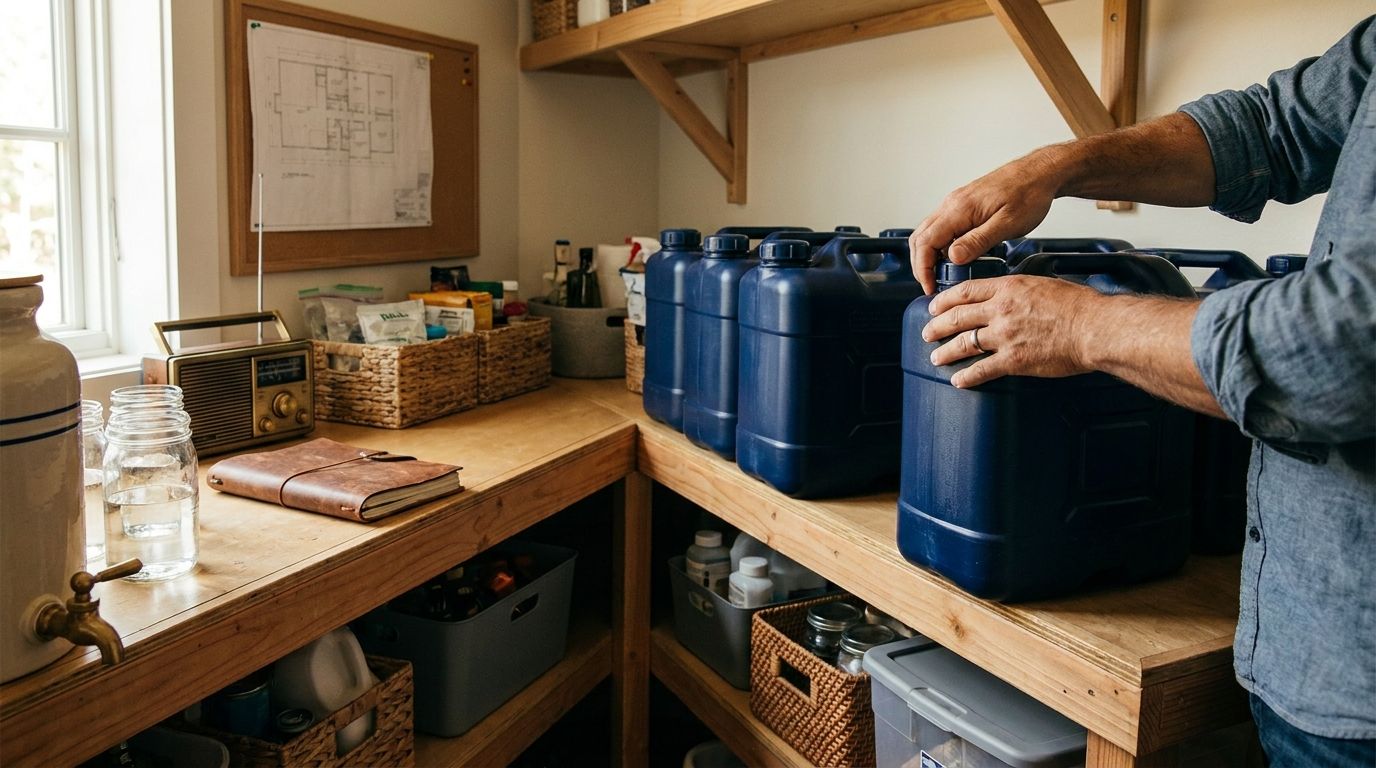
Choose containers that match how you rotate
You need containers that:
- Seal reliably
- Are easy to pour and handle
- Fit where you store them
Many households use a mix:
- Ready-to-use containers (easy to grab)
- Larger jugs or drums (more volume, less frequent handling)
Food-grade containers reduce the risk of contamination from the container itself. Non-food-grade containers risk off odors, plastic leaching, or a seal that gives out at the wrong moment.
Store water where it stays stable
Heat accelerates container aging. Sunlight adds stress. Keep water in a cool, dry spot, and be deliberate about it.
Practical storage rules:
- Avoid garages that bake in summer
- Avoid windowsills
- Avoid places where you store chemicals
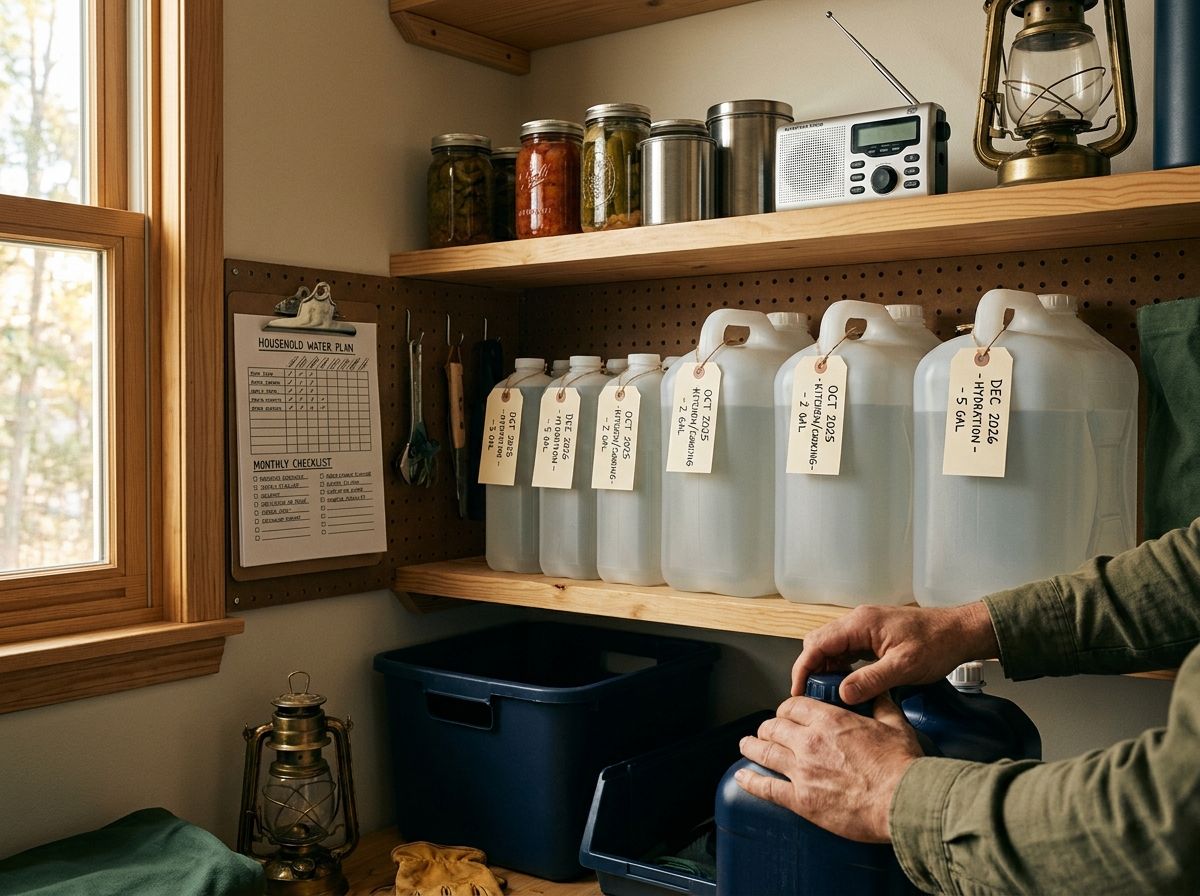
Labeling that makes rotation automatic
You already track expiration dates for food. Water needs the same discipline.
Label each container with:
- Date filled
- Date to rotate (or replace)
- What it is for (drinking vs sanitation) if you split your stash
Then set a calendar reminder for your rotation schedule. Tie it to your grocery cycle and you won't forget.
A note on "shelf life" reality
Water storage guidance often includes recommended replacement intervals. The point isn't to treat your water like it's radioactive, it's to keep your supply fresh enough that you can actually trust it.
Simple mindset: treat stored drinking water the way you treat canned goods. Rotate it into use and replace it before it becomes "mystery water."
A refill and rotation plan you can actually run
A plan that lives only on paper is just a nice story. A plan that runs on a calendar becomes a habit.
Here's a clean way to run water planning in real life.
Step 1: set your target and split it into zones
Make two zones in your home:
- Zone A: drinking water (grab-fast)
- Zone B: sanitation water (support)
Rosa Wills, for example, keeps drinking jugs stacked near the kitchen pantry and sanitation water in a separate bin in the hallway closet. This reduces decision fatigue during a stressful moment. You don't want to sort water while you're also figuring out what's safe.
Step 2: choose your rotation method
You have two practical methods:
- Use stored water on a schedule (pour into sinks, refill jugs)
- Treat stored water as drinking-only and rotate by replacing containers on schedule
If you rotate by using, you must refill. If you rotate by replacing, you must budget replacements.
Most households do better with a hybrid. Use some water for non-critical tasks first, then replace containers on a calendar.
Step 3: run a "how much is left" check
Once a month, you should be able to answer:
- How many gallons are in Zone A?
- How many gallons are in Zone B?
- When is the next refill or replacement date?
Five minutes. That's it. It also prevents the slow drift where your supply looks fine until you actually count.
Step 4: document the plan for everyone
Your family emergency plan already covers roles. Water planning needs a place in it.
Include:
- Where the water is
- How to grab it quickly
- Which water is for drinking
- How you rotate it
If you have a dog, include the dog's water location and a simple rule: dog water comes from the same storage stash every time.
With Mainstay's adaptive learning system, you can keep this documentation alongside your inventory so you don't rebuild it every year.
Common mistakes that quietly break water planning
Most water planning failures come down to a few predictable gaps. Here's where to watch.
Mistake 1: you store the number, but not the access
If your water is buried behind boxes and seasonal decor, you will not use it quickly. You'll hesitate. That hesitation costs you time and pushes you toward rationing.
Rule: store water where you can reach it in under 30 seconds.
Mistake 2: you mix drinking and sanitation water without labels
When labels are missing, you end up guessing. Guessing is what turns a calm plan into a tense conversation.
Rule: label containers by purpose.
Mistake 3: you plan for 3 days, but your household plan assumes 1 day
This mismatch shows up when people say, "We'll be fine by tomorrow," while your family emergency plan runs on a longer timeline. Pick a timeline and hold it consistently.
Rule: your water days should align with your household preparedness plan.
Mistake 4: you ignore heat and activity
1 gallon per person per day is a planning baseline. It is not a guarantee. If you live in a hot climate or expect heavy activity, add buffer.
Rule: adjust for the scenario, not for optimism.
Mistake 5: you don't rotate
Water rotation is boring. That's exactly why it works when you actually do it. A reliable supply is a rotated supply.
Rule: schedule rotation like you schedule oil changes. Small effort, real payoff.
FAQ
How much water should I store for an emergency for my household?
A common CDC water storage guidance baseline is about 1 gallon per person per day, planned for 3 days for drinking and basic use. Many households add extra water for sanitation, depending on bathroom setup and how they plan to manage hygiene.
What is the emergency water supply amount for a family of four?
For drinking water alone, 1 gallon per person per day for 3 days means about 12 gallons for a family of four. If you also want sanitation and limited flushing support, many households add an additional 25% to 50% buffer.
How often should I rotate stored water?
Rotate or replace on a schedule tied to your container type and your labeling dates. The main goal is to avoid "mystery water" you can't trust. Label fill dates and replacement dates, and rotation becomes a calendar task instead of a yearly surprise.
What containers are best for water storage?
Use containers designed for water storage that seal reliably. Store them in a cool, dry place away from sunlight and chemicals. If you choose containers that are hard to access or awkward to pour, your plan will fail at the moment you need it most.
Should I include water for pets in my water planning?
If you want your household to function normally during an outage, include pet water. Store it separately so it stays easy to grab and doesn't get mixed into your drinking supply.
Your next step: calculate your number and label your plan
Pick your scenario first. Then calculate your core drinking water total at 1 gallon per person per day for the days you plan to cover. Add a sanitation buffer that matches your bathroom reality.
Then do the part that makes it real: label your containers with date filled and purpose, and set one calendar reminder to rotate or replace. That's how water planning stays calm, organized, and dependable when the moment shows up.
Want this handled automatically? See the Mainstay membership.
Subscribe to comment
Join the Mainstay newsletter to leave a comment — and get new field notes in your inbox.
Get new field notes in your inbox
Practical, calm preparedness — one useful note at a time.