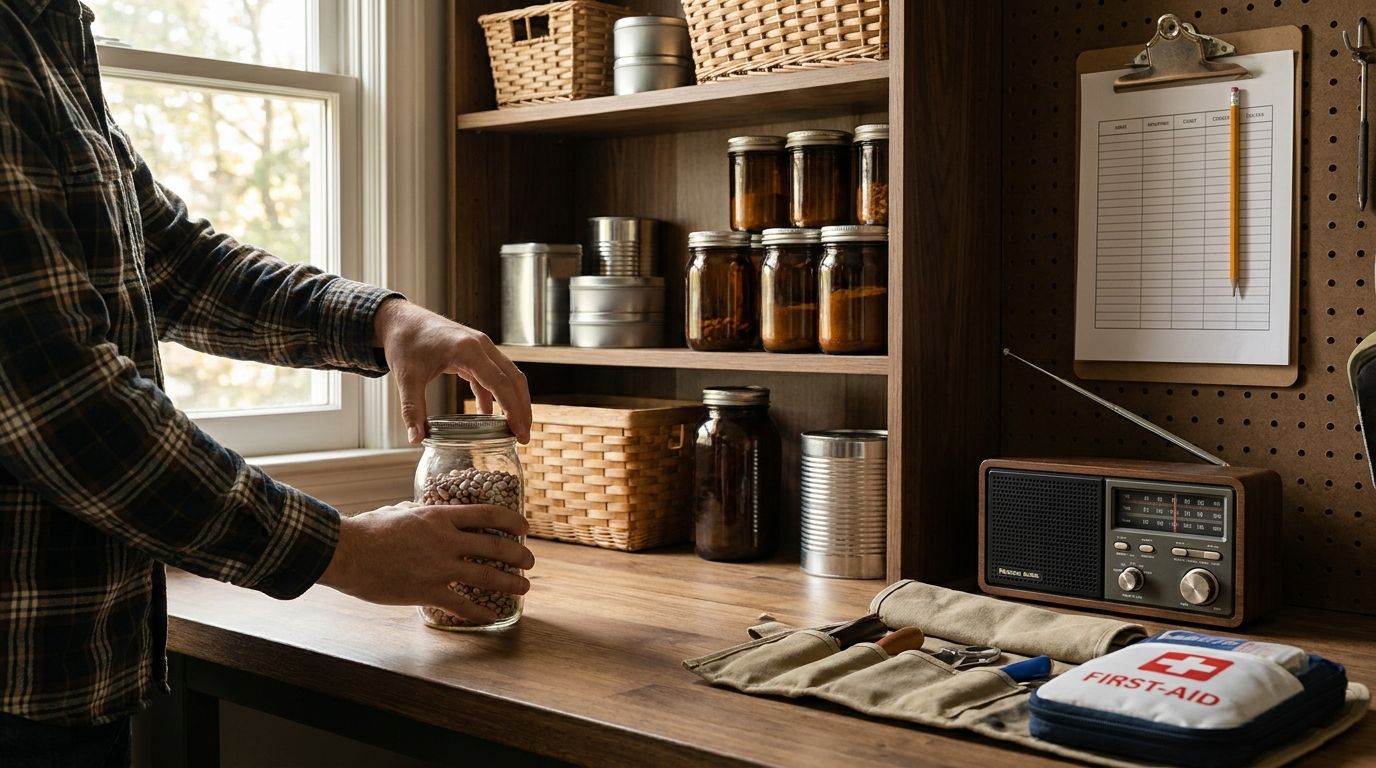
Water rotation schedule you’ll follow: build a refill plan without guesswork
A water rotation schedule that matches real container lifetimes. You’ll set reorder dates, track water storage expiration, and keep your household water inventory current.
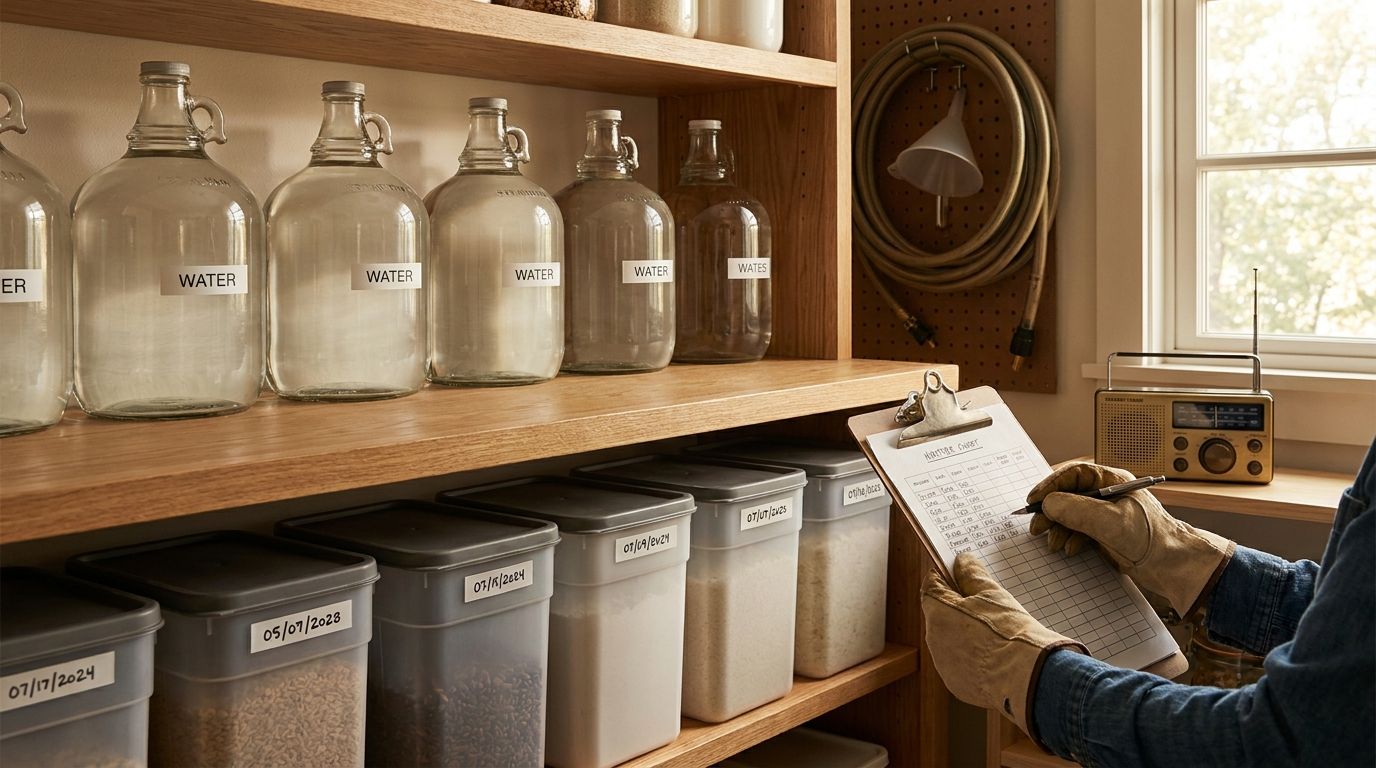
Rosa opens the pantry, squints at a row of bottles she filled last summer, and can't remember which ones get used first. The kettle is on, the family is moving, and the water plan should be doing the same quiet job as everything else in the house.
A solid water rotation schedule answers two questions: what you have, and when you refill it. This guide shows you how to build a refill plan that lines up with container lifetimes and your actual routines, so "rotate later" doesn't turn into "whoops."
Start with the inventory you already have (not the one you wish you had)
Before you touch a single bottle, build a household water inventory you can check in under five minutes. Not fancy. Just reliable enough that you stop depending on memory.
Walk through your home with a notepad or phone and list every water storage item you treat as "backup water." That includes:
- Bottled water you keep for drinking
- Water stored in jugs or containers
- Any sealed water you rotate through for normal use
- Water you store for pets, too (if you do)
Then write down what matters for rotation, not just quantity:
- Container type (bottled plastic, HDPE jug, stainless, etc.)
- Capacity per container (for example, 1 gallon, 16.9 oz, 5 gallons)
- Purchase or fill date (whatever you actually know)
- Expiration date if it is printed on the label
- Where it sits (pantry shelf, garage cabinet, under-sink bin)
Because you are building a water rotation schedule, also record a simple "how it moves" note for each item. Something like "Used for daily cups on weekdays" or "Only used during power outage practice." That single line keeps you from rotating the wrong thing.
Here's why this matters: water storage expiration depends on container and conditions. The CDC and FEMA both emphasize routine replacement and labeling, and manufacturers publish shelf-life guidance that changes by product type. Even if you trust the label, you still need a schedule that makes you act before the date slips.
So yes, you are doing inventory. But you are doing it once, cleanly, and then you let the schedule carry the workload.
Match your rotation to the container shelf-life, not the calendar mood
A water storage expiration date is not one universal number. It is a range based on how the water is packaged and how the container is stored.
Start with what you can verify:
- If your water is commercially bottled, use the manufacturer's printed expiration date.
- If your water is stored in jugs you filled, use the guidance from the container and water treatment method you used.
- If you cannot find guidance, treat it as "replace on a conservative timeline" and document why.
In practice, most people end up with a mix. That mix is where guesswork happens. You fix it by building rotation around the earliest "replace-by" date in each category.
Use this rule for your refill plan:
- Group items by container type and label guidance.
- For each group, assign a "rotation trigger date" that is earlier than the final expiration date.
- Rotate the group together so you do not end up with random one-off bottles.
A rotation trigger date is your buffer. If the printed date is 12 months away, your trigger might be 2 months earlier. To keep it simple, set your trigger at 90 days before the earliest expiration in that group.
Concrete example: Sam Wills keeps 1-gallon jugs in a basement utility closet and 16.9 oz bottled water in the pantry. The basement closet stays cool, but the pantry is warmer and gets direct light during certain seasons. The jugs and bottles should not share the same trigger date. Set one date for both and you either rotate too early or too late. Either way, you lose.
Concrete example: In the kitchen cabinet by the sink, Theo Wills grabs a bottle for convenience during dishes. That bottle belongs in the daily-use rotation category, not the "sealed backup" category. When you rotate daily-use water, you are not burning through your supply. You are using it on purpose, which is exactly the point.
With Mainstay's adaptive learning system, you can treat each container group like a repeatable workflow: inventory entry, rotation trigger, refill action, and a quick documentation check. The system helps you keep the household water inventory coherent even when you add new supplies mid-year.
Build a refill plan that fits your household rhythm
A refill plan fails when it asks you to do something at the wrong time. Your schedule needs to match when you already buy groceries and when you already have space.
So you build it around your routines. Not around "someday."
Set up three "touchpoints" you can repeat without drama:
1) Weekly check (5 minutes)
2) Monthly refill action (15 to 30 minutes)
3) Quarterly reset (45 minutes to reorganize and confirm dates)
Each touchpoint has a specific job. That is what keeps the system from collapsing into a vague intention.
Weekly check: confirm the next trigger
Every week, look at your list and confirm what is coming up next. You are not counting every bottle. You are checking the next rotation trigger date.
If the next trigger is within 30 days, note it. If it is not, move on. This keeps the water rotation schedule from becoming a full-time hobby.
Monthly refill action: refill the group that is due soonest
On your monthly refill action day, you refill one group, not five. You keep momentum and avoid the "all at once" scramble.
A practical way to do this:
- Take one group off the shelf
- Use it as drinking water for normal days or as practice water during meal planning
- Replace it with new stock
- Update dates immediately
This is where the refill plan becomes real life. You are using the water in normal routines, not waiting for some future moment to arrive.
Quarterly reset: reorganize by "replace-by" order
Every three months, reorganize so the soonest-to-expire group sits at the front and the newest sits behind it. Under an hour, start to finish.
Concrete example: In the garage near the water heater, June Wills keeps a small stack of jugs. In spring, sunlight hits that area more directly. During a quarterly reset, she moves those jugs to a cooler cabinet and puts the next-to-rotate group at eye level. The schedule stays accurate because the storage stays consistent.
Turn your dates into action: labeling and documentation that do not slip
You can have the best water rotation schedule in the world and still lose it if you do not label.
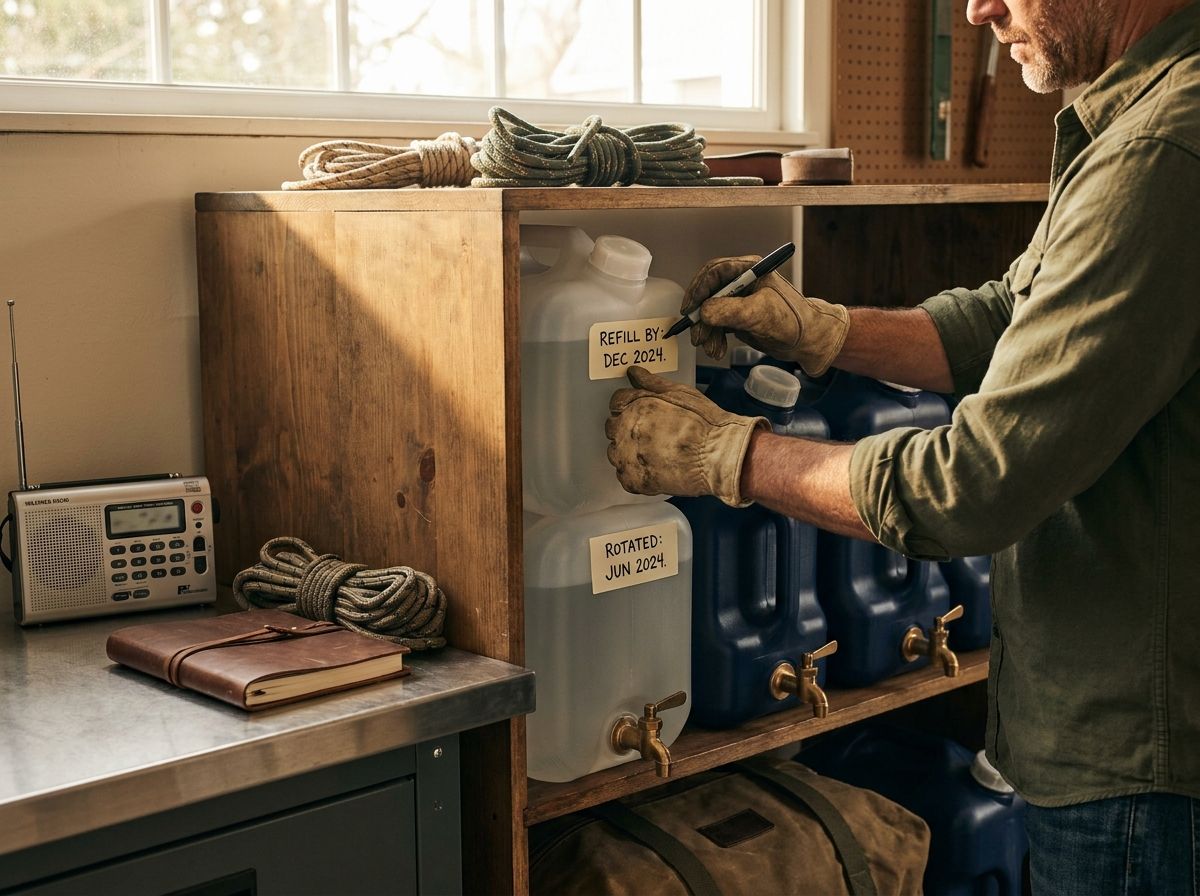
Labeling is not decoration. It is the interface between your future self and your current self (I know that sounds dramatic for a jug of water, but it is genuinely true).
Use a simple label format you can read without opening anything:
- Item name or container size
- Fill date or purchase date
- Replace-by date
- Group name (optional but helpful)
Put the label on the container and also in your inventory list. If you store multiple jugs in the same spot, label the shelf zone too.
Documentation matters because water storage expiration is only meaningful if you can find it later. Manufacturers print expiration dates tied to their own packaging conditions. If you filled your own containers, you need to track your fill date.
Here's a method that works in real kitchens:
- Create one "Water" section in your family file (paper or digital)
- Add a table for each container group
- Include a photo of each label type you use
If you already built a one-page family file for other readiness tasks, this fits right in. Keep it simple and keep it close.
Also, document what you did when you rotated. A short note like "Used for daily cups March 3-10, replaced March 11" is enough. That note prevents duplicate work and helps you keep household water inventory aligned with how you actually consume water.
And yes, you will forget once. Normal. The system is built to catch you when you do.
Use real scenarios to stress-test your rotation schedule
A refill plan should survive contact with real life: busy weeks, forgotten purchases, and space that shrinks without warning.
Here are three scenarios you can run through with your current inventory.
Scenario 1: The "we're out of room" month
You set a rotation trigger for five-gallon jugs. Then a stack of bins shows up and takes the space.
What you do:
- During your monthly refill action, rotate the soonest group into normal use immediately
- Do not store the new jugs in the old spot until you clear it
- Keep one designated "water zone" so the schedule does not get buried
This is why your inventory list should include where each group sits. If the water zone is clear, the schedule stays executable.
Scenario 2: The "label is missing" problem
Sometimes you get a container with no printed date, or you used a marker that faded.
What you do:
- Mark it with the best-known date you can verify (purchase receipt, delivery email, or approximate month)
- Set a conservative replace-by date based on container type
- Make a note in the inventory list that the date is an estimate
The rotation schedule is still useful. You are not trying to create certainty you do not have. You are trying to eliminate guesswork.
Scenario 3: The "we used the wrong water" week
A bottle gets into the rotation by accident. Then you realize the bottle you used was from your "backup only" category.
What you do:
- Adjust the schedule. No drama.
- In your weekly check, update the group's next replace-by date based on what you actually consumed
- Keep the new replacement date in the same month so your refill plan stays steady
This scenario is common because life is messy. Your job is to keep the household water inventory accurate enough that the next action is clear.
If you want a research anchor while you do this, public health agency guidance consistently recommends periodic replacement of stored water and proper container conditions. The exact "how often" varies by product, but the principle holds: sealed storage is not a set-it-and-forget-it situation.
Keep it from slipping: the weekly check and the reorder point mindset
Your water rotation schedule should have guardrails.
Two ideas do that work: a weekly check that keeps the next action visible, and reorder points that keep you from running short.
Weekly check: confirm the next trigger and the next refill date
Your weekly check is a glance, not an audit. You look at your inventory list and confirm:
- What group has the soonest rotation trigger date
- Whether you already replaced it in the current month
- Whether any labels need updating
Do this consistently and you catch problems early. Skip it for a few months and you catch them late, which is a worse Tuesday.
Reorder point mindset: refill before you hit empty
For water, treat reorder points like this:
- When a group drops below your "safe minimum," schedule its refill
- Do not wait until you are out
Pick your safe minimum based on your household water plan. If your plan includes drinking and basic sanitation needs, you likely want a buffer beyond what you use on normal days.
Concrete example: Rosa Wills keeps a small set of drinking bottles for weekend guests and uses one jug for daily water when it is convenient. Her safe minimum is not "zero." It is "enough for guests plus one week of normal use." When the jug count drops near that minimum, her refill plan schedules the next replacement.
Make the schedule easy to execute. Keep the shopping list ready, keep a "water zone" in the pantry or garage, and keep one person responsible for the monthly refill action, even if more than one person helps.
You are building competence, not anxiety.
FAQ
How do I build a water rotation schedule if my containers have different expiration dates?
Group your household water inventory by container type and label guidance. Assign a rotation trigger date for each group that is earlier than the earliest replace-by date in that group. Rotate and refill one group at a time on your monthly action day so the schedule stays manageable.
What does "water storage expiration" actually mean for stored water?
It is the manufacturer or guidance-based timeline for when the stored water is expected to stay in good condition under proper storage. Conditions like heat, light, and container material affect results. Use the printed dates when available, and use conservative dates when you filled or stored water without clear labeling.
How often should I refill my backup water?
Most people refill on a schedule aligned to the product guidance for their container type, then add a buffer so the rotation happens before the replace-by date. A practical approach is to rotate within 60 to 90 days of the earliest expiration in a group, then replace immediately so the group's timeline resets.
What's the easiest way to label water storage expiration dates?
Use one consistent label format: container size, fill or purchase date, and replace-by date. Put the label on the container and record the same dates in your water inventory list. If labels fade, add a shelf label for the group and update your inventory immediately.
Do I need to rotate bottled water the same way as water I stored in jugs?
Not necessarily. Commercial bottled water uses the printed expiration date from the manufacturer. Water stored in jugs you filled depends on the container and your fill method, so its timeline can differ. Keep them in separate groups so your water rotation schedule matches reality.
Next step: make your first refill plan in 30 minutes
Pick one container group today. Write down its replace-by date, choose a rotation trigger date (90 days before the earliest expiration in that group), and schedule your monthly refill action for the month you want it to happen. Then label the containers and update your water inventory list immediately.
Do that once, and the rest gets easier. Your next weekly check will tell you exactly what to do, and you will not need to guess.
Want this handled automatically? See the Mainstay membership.
Subscribe to comment
Join the Mainstay newsletter to leave a comment — and get new field notes in your inbox.
Get new field notes in your inbox
Practical, calm preparedness — one useful note at a time.